
How C-REPS Professionals Give Back to Their Communities

Real estate transactions touch families, neighborhoods, and local economies. A home sale can shape a household’s finances for decades, and a single pricing decision can affect an entire street. For that reason, the people who guide these transactions carry a responsibility that extends well beyond their commissions. C-REPS professionals take that responsibility seriously. They pair certified pricing expertise with a commitment to the communities where they live and work.
This article explains what giving back looks like in the real estate profession, how the C-REPS standard shapes community involvement, and which specific contributions make the biggest difference. It also offers practical guidance for anyone who wants to evaluate whether an agent’s community commitment is genuine.
What Giving Back Means in Real Estate
Giving back is a broad idea, and in real estate it can take many forms. Some agents donate money or time to local charities. Others focus on education, helping residents understand how the housing market works. Still others channel their professional skills into projects that benefit the people around them.
The strongest examples of community contribution share a common feature: they draw on the professional’s core expertise. A pricing specialist can help neighbors understand what their homes are worth. A market analyst can share trends that help first-time buyers plan. A licensed agent who knows local zoning, inventory, and buyer behavior can offer insight that few other people in a neighborhood possess.
Why Community Involvement Matters for Agents
Real estate professionals depend on local trust. Buyers and sellers want to work with someone who understands their town, respects their neighbors, and will still be around after the closing table. Community involvement builds that trust over time. It shows that an agent’s interest extends past a single transaction and into the long-term health of the place they serve.
Community involvement also creates a useful feedback loop. Agents who spend time listening to residents learn which concerns come up repeatedly, whether that is rising property taxes, a shortage of starter homes, or confusion about disclosure rules. That knowledge improves their work with clients.
The C-REPS Standard: Professional Ethics as a Foundation for Service
C-REPS (Certified Real Estate Pricing Specialists) is a network of certified, professional real estate agents and brokers who specialize in accurate property pricing and market expertise. C-REPS professionals are trained, tested, and certified through the National Association of BPO Professionals (NABPOP) certification program.
The designation requires agents to complete specialized training, pass certification exams, meet performance requirements, maintain membership, and follow a professional code of ethics. Each of these elements supports community contribution in its own way.
Certification and Accountability
Certification sets a baseline of competence. When an agent has completed structured training and passed examinations, clients and neighbors have a reasonable basis for confidence in that agent’s knowledge. Performance requirements and ongoing membership add accountability, because the professional must keep meeting standards over time rather than relying on a credential earned years ago.
For community members, this matters in a practical way. Someone deciding whether to trust a local agent with a family’s most important financial decision benefits from knowing that the agent operates under recognized standards and a published code of ethics.
The Collaborative Network
C-REPS professionals are not solo practitioners. They work within a collaborative professional network, which means knowledge, resources, and standards are shared across members. This structure allows agents to learn from peers, refine their pricing methods, and bring a broader perspective to local questions. It also means community-minded practices can spread across the network rather than remaining isolated to one office.
Five Ways C-REPS Professionals Contribute
Community contribution looks different from one agent to the next. The following areas represent common and meaningful ways C-REPS professionals serve their neighborhoods.
Local Market Education
Many residents feel uncertain about the housing market. They hear conflicting reports about prices, interest rates, and inventory, and they may not know which information to trust. C-REPS professionals can help by offering clear, accurate explanations of local conditions. This might take the form of neighborhood workshops, informational sessions at community centers, or plain-language guides shared through local channels.
The goal of this education is to help people make informed decisions, whether or not they ever hire the presenting agent. An informed community is a healthier community.
Honest Pricing as a Community Service
Accurate pricing is one of the most underrated forms of community contribution. When a home is priced too high, it can sit on the market, become stale, and eventually sell for less than it could have with a realistic starting point. When a home is priced too low, sellers lose money they were entitled to keep. Both outcomes affect the broader neighborhood, because comparable sales feed into the valuations of nearby properties.
C-REPS professionals approach pricing with a rigorous method that combines formal training with real-market knowledge. They focus on what buyers are actually willing to pay today in the local market. This disciplined approach protects individual sellers and helps keep neighborhood price data reliable for everyone.
Volunteering and Neighborhood Support
Many C-REPS professionals volunteer their time with local organizations. Common areas of involvement include housing nonprofits, neighborhood associations, food banks, youth programs, and school support groups. Volunteering allows agents to contribute skills, time, and energy in ways that align with their values.
Agents who volunteer consistently often develop deeper relationships in the community. These relationships are not a sales tactic when they grow from genuine participation. They are a natural result of showing up for the people and causes that matter locally.
[Insert specific local volunteer examples here, such as the organizations your agents support and the roles they play.]
Supporting First-Time Buyers and Housing Access
Buying a first home can feel overwhelming, especially for people unfamiliar with mortgage terminology, inspection processes, or the steps of a purchase agreement. C-REPS professionals can support first-time buyers by explaining each stage clearly, setting realistic expectations about budgets, and helping them avoid common mistakes.
This kind of guidance has a community dimension. When more residents become confident homeowners, neighborhoods gain stability and investment. Agents who take time to educate new buyers help build the kind of long-term local ownership that strengthens a town.
Mentoring and Professional Development
Strong communities also depend on strong professionals. Experienced C-REPS agents can mentor newer agents, sharing knowledge about pricing methods, client communication, and ethical practice. This mentorship raises the overall quality of service available to the public. It also reflects the collaborative spirit of the network, where professional growth benefits everyone.
Corporate Responsibility and Brand Values
Corporate responsibility is a term often used in business, and it applies to real estate firms and independent agents alike. It refers to the idea that a business has obligations to its customers, employees, and community, not just to its shareholders or owners. In practice, corporate responsibility shows up in how a firm treats clients, how it handles information, and how it contributes to the places it serves.
The table below compares a traditional, transaction-focused approach with the approach that C-REPS professionals aim to practice.
| Area | Transaction-Focused Approach | C-REPS Approach |
| Pricing | Set price to win the listing | Price based on trained analysis of current local demand |
| Credentials | Licensed only | Certified through structured training, examinations, and a code of ethics |
| Client relationship | Focused on closing | Focused on long-term guidance and accurate information |
| Community role | Occasional or unspecified | Ongoing education, volunteering, and neighborhood support |
| Professional standards | Minimum legal requirements | Higher ethical and performance expectations |
| Network | Individual practice | Collaborative professional network |
This comparison is not meant to criticize every agent outside the C-REPS network. Many professionals serve their communities with integrity. The difference lies in the structure of the standard itself. C-REPS professionals agree to meet defined expectations, and those expectations explicitly include ethical conduct and ongoing professional commitment.
Practical Examples of Community Contribution
Abstract principles become clearer through specific cases. Consider the following scenarios that illustrate how community contribution can work in practice.
Example one: A neighborhood pricing workshop. An agent hosts a free evening session at a local library to explain how comparable sales are selected and how market conditions affect value. Attendees leave with a clearer understanding of how appraisals and listing prices relate to actual buyer behavior. Several homeowners later reach out with questions, and a few choose to work with the agent, but the session’s primary goal was education.
Example two: Guiding a first-time buyer through a difficult market. A young couple wants to buy their first home but feels discouraged by competitive offers. A C-REPS professional walks them through realistic budgeting, explains how pricing works in their target neighborhood, and helps them avoid overpaying in a bidding situation. The couple secures a home they can afford, and the agent gains a long-term client who later refers friends.
Example three: Helping a senior homeowner plan a downsizing decision. A longtime resident wants to sell a family home and move to a smaller property nearby. The agent provides an accurate valuation, explains the timing options, and connects the family with trusted local resources for moving and estate planning. The resident feels respected rather than pressured.
Example four: Supporting a local housing nonprofit. An agent volunteers to share pricing and market knowledge with a nonprofit that helps families access affordable housing. The agent’s expertise helps the organization set realistic program parameters and better understand local conditions.
[Replace or supplement these examples with verified, real stories from your C-REPS network members, with permission.]
How to Evaluate an Agent’s Community Commitment
If you are looking for a real estate professional, community involvement can be a useful indicator of values. It is not the only factor, and you should always evaluate an agent’s credentials, experience, and fit with your needs. However, the following questions can help you assess whether an agent’s commitment to the community is genuine.
- Ask whether the agent holds a recognized professional certification and what that certification requires.
- Ask how the agent determines a home’s price and what data sources they rely on.
- Ask which local organizations the agent has supported and what role they played.
- Ask whether the agent offers educational resources or community sessions.
- Ask how the agent handles situations where the most profitable option for them differs from the best option for you.
- Look for consistency. Long-term involvement tends to be more meaningful than a single event.
A good agent will answer these questions openly and without pressure. If an agent deflects, becomes vague, or emphasizes urgency rather than information, that response is worth noting.
Conclusion
Giving back is not a separate activity for C-REPS professionals. It flows naturally from the standards they follow, the expertise they develop, and the communities they serve. Through certification, honest pricing, local education, volunteering, and mentorship, these professionals contribute to neighborhoods that are better informed and more stable.
If you are considering a move, a sale, or a purchase, consider looking for an agent whose values match your own. Ask questions, look for consistency, and choose someone who treats your decision with the seriousness it deserves. Communities grow stronger when the people guiding their most important transactions care about the long-term health of the place they call home.
Frequently Asked Questions
What does C-REPS stand for?
C-REPS stands for Certified Real Estate Pricing Specialists. It is a network of certified, professional real estate agents and brokers who specialize in accurate property pricing and market expertise.
How do C-REPS professionals get certified?
C-REPS professionals are trained, tested, and certified through the National Association of BPO Professionals (NABPOP) certification program. The designation requires specialized training, certification exams, performance requirements, ongoing membership, and adherence to a professional code of ethics.
How is a C-REPS professional different from an average real estate agent?
C-REPS professionals complete structured certification and agree to a higher set of professional and ethical standards. They combine formal pricing training with real-market knowledge and work within a collaborative network rather than operating in isolation.
How do C-REPS professionals give back to their communities?
Common contributions include offering local market education, providing accurate pricing that protects sellers and neighborhood data, volunteering with local organizations, supporting first-time buyers, and mentoring newer agents. The specific activities vary by agent and region.
Why does accurate pricing count as a community contribution?
Accurate pricing protects individual sellers from losing money through overpricing or underpricing. It also keeps comparable sales data reliable, which affects valuations for nearby homes. Consistent, honest pricing supports a more stable local market.
Can I work with a C-REPS professional if I am a buyer?
Yes. C-REPS professionals serve home buyers, home sellers, homeowners, and investors. Buyers benefit from agents who understand what properties are actually worth in their target area, which can help them negotiate with confidence.
Do I need to be a homeowner to benefit from community education sessions?
No. Most community education efforts are open to residents, renters, and prospective buyers. Local libraries, community centers, and neighborhood associations are common places to find these sessions.
How can I find a C-REPS professional near me?
You can start by searching for C-REPS members in your area and reviewing their profiles, certifications, and community involvement. Asking direct questions during an initial conversation will also help you judge fit.
C-REPS Networking Events and Community Involvement: How a Professional Network Strengthens Real Estate Expertise

Buying or selling a home is one of the largest financial decisions most people make, and the professional who guides that decision matters. Many consumers quickly learn that not every real estate agent brings the same training, the same standards, or the same depth of local market knowledge. The C-REPS professional network was built to address that gap, and its networking events and community involvement are a large part of how it does so.
This article explains what the C-REPS community is, how its networking events work, why collaboration among certified professionals benefits the public, and how consumers can use this knowledge when choosing an agent.
What Is the C-REPS Professional Network?
C-REPS stands for Certified Real Estate Pricing Specialists. It is a network of certified real estate agents and brokers who focus on accurate property pricing and market expertise. Members are active licensed professionals, not appraisers, who have chosen to add specialized pricing training to their everyday work.
Members are trained, tested, and certified through the National Association of BPO Professionals (NABPOP) certification program. The designation requires agents to complete specialized training, pass certification exams, meet performance requirements, maintain their membership, and follow a professional code of ethics. Those requirements exist so that a C-REPS designation signals more than a name on a business card.
Who Are C-REPS Professionals?
C-REPS professionals share several common traits:
- They are active real estate agents or brokers.
- They commit to ongoing professional development and continuing education.
- They combine systematic pricing training with deep knowledge of their local markets.
- They work as part of a collaborative network rather than as isolated practitioners.
- They are held to higher professional and ethical standards than the average agent.
That final point matters for consumers. The industry includes many talented agents, but it also includes people who are new, part-time, or focused mainly on closing a quick transaction. A certification program with defined standards gives buyers and sellers a clearer way to evaluate who they are working with.
Why Networking Matters in Real Estate Pricing
Pricing a home well depends on more than comparing a few recent sales. Accurate pricing requires understanding what buyers are actually willing to pay today, how neighborhoods are shifting, which features are drawing offers, and how local conditions differ from one street to the next.
No single agent sees every transaction in a metro area. A collaborative network allows professionals to share perspectives, compare observations, and learn from one another’s experience. For a consumer, this means the expertise behind a single agent can be broader than that agent’s personal caseload.
This is the core idea behind C-REPS networking. The network is designed so that professionals strengthen one another’s work, and the public benefits from that shared knowledge.
Inside a C-REPS Networking Event
C-REPS networking events bring certified members together to exchange knowledge, discuss market conditions, and build the working relationships that make collaboration possible. While formats can vary by region and season, most professional networking gatherings in the C-REPS community share a few common goals.
Common Goals of Networking Gatherings
- Market discussion: Members compare what they are seeing in their local areas, including shifts in buyer demand, inventory trends, and pricing patterns.
- Training and professional development: Events often reinforce pricing methods, ethical standards, and best practices.
- Relationship building: Members get to know one another in person, which makes future referrals and collaboration more natural.
- Peer learning: Experienced professionals share approaches that have worked for them, and newer members gain practical perspective.
What Attendees Typically Gain
Professionals who participate in networking events often come away with clearer insight into how their own markets compare with others. They also build a reference network of colleagues they can consult when a transaction involves an unfamiliar property type or price range.
For consumers, the value shows up indirectly. An agent who stays connected to a professional community tends to have more current market information, more perspectives to draw on, and a stronger habit of continuing education.
Community Involvement Beyond the Event Room
Networking is not limited to scheduled gatherings. C-REPS community involvement extends into the everyday ways professionals serve their clients and their neighborhoods.
Ways Members Stay Engaged
- Participating in continuing education and certification maintenance
- Sharing market observations with fellow members
- Mentoring newer professionals who are building their pricing skills
- Supporting local buyers and sellers with accurate, data-informed guidance
- Maintaining the ethical standards the designation requires
Community involvement also reflects a broader philosophy. C-REPS professionals see themselves as market makers who know real buyers, real sellers, and real prices. That perspective encourages members to stay grounded in what actually happens in their communities rather than relying on outdated assumptions.
The Difference Teamwork Makes for Clients
One of the most distinctive features of C-REPS is its collaborative structure. When you hire one C-REPS agent, you gain access to the broader network. That means your agent can draw on colleagues’ knowledge when your property or your market presents an unusual challenge.
Consider a practical example. A homeowner in a neighborhood with few recent sales of similar homes wants to know a realistic list price. A single agent working alone may struggle to find comparable data. A C-REPS professional can consult fellow members who work in adjacent areas or who have handled similar properties, then bring that combined perspective back to the homeowner.
How Collaboration Can Help Different Clients
- Home sellers benefit from pricing informed by a wider set of market observations, reducing the risk of overpricing or leaving money on the table.
- Home buyers gain insight into whether an asking price reflects current local demand.
- Homeowners and investors can receive valuations grounded in both training and real-market knowledge.
- Anyone entering an unfamiliar area can tap into local knowledge from members who already work there.
How C-REPS Differs From a Typical Agent Search
Many people begin their agent search by looking at online reviews or asking friends. Those are useful starting points, but they do not always reveal how an agent approaches pricing or ethics. Certification adds another layer of evidence.
| Factor | Typical Agent | C-REPS Professional |
| Pricing training | Varies widely | Specialized training and testing required |
| Certification | Often a general license only | Certified through NABPOP program |
| Market approach | Often relies on individual experience | Combines training with real-market knowledge |
| Network access | Usually limited to the individual or brokerage | Access to a collaborative professional network |
| Ethical standards | Set by license requirements | Follows a professional code of ethics as a condition of membership |
| Ongoing commitment | Varies | Requires maintaining membership and performance standards |
This comparison does not mean every agent outside the network is unqualified. It means certification provides a structured way to verify commitment to professional standards.
Questions to Ask Any Agent You Are Considering
Whether or not you choose a C-REPS professional, asking the right questions helps you find a trustworthy agent. Consider asking:
- What training or certifications have you completed related to pricing?
- How do you determine what buyers are willing to pay in my specific area?
- Do you participate in any professional networks or continuing education programs?
- How do you handle situations where my property has few comparable sales?
- What ethical standards guide your work?
A strong agent will answer these questions clearly and will not pressure you to decide immediately.
Practical Steps for Consumers
If you are looking for a certified professional, these steps can help you make an informed choice:
- Verify credentials. Ask for proof of any certification you are considering, and confirm it is current.
- Compare approaches. Ask each agent how they would price your home or evaluate a purchase, and compare the reasoning, not just the number.
- Check local knowledge. Ask how long the agent has worked in your area and what they have observed recently.
- Review professional commitment. Look for signs of continuing education and active participation in professional communities.
- Trust your instincts. A professional who explains their process patiently is usually a good sign.
Frequently Asked Questions
What does C-REPS stand for?
C-REPS stands for Certified Real Estate Pricing Specialists. It is a network of certified agents and brokers who focus on accurate property pricing and market expertise.
Who certifies C-REPS professionals?
C-REPS professionals are trained, tested, and certified through the National Association of BPO Professionals (NABPOP) certification program.
Are C-REPS professionals appraisers?
No. C-REPS members are active real estate agents and brokers. Their pricing training is designed for their work as licensed agents, which is different from the role of a licensed appraiser.
What happens at a C-REPS networking event?
Networking events bring certified members together to discuss market conditions, share training insights, and build professional relationships. Formats can vary by region.
How can I benefit from the C-REPS network if I hire one agent?
When you work with one C-REPS professional, that agent can draw on the collaborative knowledge of the broader network, which can be especially useful for unusual properties or unfamiliar markets.
Do C-REPS professionals follow a code of ethics?
Yes. Certification requires agents to follow a professional code of ethics, and members are held to higher professional and ethical standards than the average agent.
How do I find a C-REPS professional near me?
Start by visiting the official C-REPS website or contacting the network directly for a listing of certified members in your area. Always confirm a member’s current certification before you commit.
Is C-REPS certification the only thing I should look for?
No. Certification is one important factor. Also consider the agent’s local experience, communication style, responsiveness, and how well they explain their pricing process.
Next Steps: Connecting With the C-REPS Community
If you value accurate pricing, professional training, and genuine client partnership, the C-REPS network is worth exploring. Whether you are preparing to sell, looking to buy, or simply want a valuation you can trust, a certified professional can help you understand your options clearly.
When you are ready, you can reach out to a certified C-REPS professional in your area to discuss your goals. There is no obligation to act immediately, and a good agent will respect your timeline.
C-REPS Industry Awards and Professional Recognition: What Credible Certification Really Means

Recognition in the real estate industry is easy to claim and harder to earn. Plenty of agents display logos, badges, and titles on their websites, but few of those credentials require training, testing, ongoing performance standards, and a commitment to a professional code of ethics. When you are deciding who to trust with one of the largest financial transactions of your life, that difference matters.
This guide explains what professional recognition means in the context of C-REPS, the Certified Real Estate Pricing Specialist network, and how to evaluate the credibility behind any agent’s credentials. Whether you are selling a home, buying one, or simply want an accurate valuation, understanding what sits behind a designation will help you make a more confident choice.
What Is C-REPS?
C-REPS stands for Certified Real Estate Pricing Specialists. It is a network of certified real estate agents and brokers who specialize in accurate property pricing and market expertise. The network is built around a simple idea: pricing a home well requires both formal training and deep knowledge of what buyers are actually willing to pay in a specific local market.
C-REPS professionals are trained, tested, and certified through the National Association of BPO Professionals (NABPOP) certification program. According to the program’s structure, the designation requires agents to complete specialized training, pass certification exams, meet performance requirements, maintain membership, and follow a professional code of ethics.
Who C-REPS Professionals Are
C-REPS members share several defining characteristics:
- They are active real estate agents or brokers, not appraisers.
- They commit to continuing education and professional development.
- They combine systematic training with local market knowledge.
- They work as part of a collaborative professional network rather than as solo practitioners.
- They are held to professional and ethical standards that go beyond the baseline for licensed agents.
Each of these characteristics contributes to the kind of recognition that matters most to consumers: evidence that the agent has been evaluated against a defined standard by an outside body.
Why Industry Recognition Matters to Consumers
Most consumers do not have the time or expertise to evaluate real estate professionals on their own. They rely on signals such as licensing, reviews, referrals, and designations. Of these, designations that require examinations and continuing education tend to carry the most weight, because they show that someone has been tested rather than simply licensed.
Professional recognition offers three practical benefits to the people you work with:
- Verified training. A certification means the agent completed structured coursework and passed an assessment, not just a general licensing exam.
- Accountability. Designation holders typically must maintain membership, meet performance requirements, and follow a code of ethics, which gives you a standard to hold them to.
- Clearer expectations. When an agent’s credentials are tied to a defined body of knowledge, you can ask specific questions about their methods and understand the answers.
It is worth remembering that recognition is a starting point. A credential tells you someone has met a standard. It does not replace your own judgment about whether that person communicates clearly, listens well, and understands your situation.
How C-REPS Differs From a Typical Agent Profile
Many agents rely on general experience and general training. C-REPS professionals are distinguished by four areas of focus.
Professional Certification
The NABPOP pathway requires training and testing to a professional standard. This matters most when pricing is the central issue, because it ensures the agent has learned a consistent, documented approach rather than relying solely on instinct or past deals.
Market Expertise
Pricing is ultimately about what buyers will pay today. A C-REPS professional is expected to understand current conditions in their local market, including recent sales, buyer behavior, and how listings are performing. This knowledge changes constantly, which is why ongoing education and active practice both matter.
Teamwork
Because C-REPS operates as a collaborative network, working with one member can give you access to the knowledge and perspective of the wider group. Instead of relying on a single person’s experience, you benefit from a network that shares standards and information.
Professional Commitment
The industry includes agents who prioritize quick commissions over long-term client results. A recognized designation with ongoing requirements is one signal that an agent is building a durable career rather than chasing the next transaction. This is not the only signal, but it is a meaningful one.
How to Evaluate Any Agent’s Credentials
Whether or not you choose a C-REPS professional, the following steps will help you assess any agent’s recognition.
Verify the Designation Directly
Do not rely solely on an agent’s website or business card. Ask which organization issued the designation, what it requires, and how it is maintained. Then confirm the credential through the issuing body’s own resources. Legitimate organizations typically have public directories or verification processes.
Ask Specific Questions
Credentials are most useful when you can connect them to real practices. Consider asking:
- What specific training did you complete for this designation?
- How do you determine a home’s price, and what data do you use?
- How recently did you update your market knowledge, and how?
- Can you walk me through a recent comparable sales analysis?
- How do you handle situations where the market is not behaving as expected?
A credible professional will answer these questions clearly and without defensiveness. Vague answers, or answers that rely only on confidence, are a signal worth noticing.
Look for Consistency
Strong credentials should align with the rest of an agent’s profile. Check whether their reviews, transaction history, and communication style match the professionalism their designations suggest. A single credential is less informative than a pattern of consistent, verifiable behavior.
Understand What a Designation Does Not Guarantee
No designation guarantees a specific sale price, a fast sale, or a particular outcome. Market conditions, property condition, timing, and buyer demand all affect results. Be cautious of any professional who promises outcomes they cannot control.
Practical Examples of Recognition in Action
Consider two sellers listing similar homes in the same neighborhood. The first chooses an agent based on a friend’s recommendation and a low commission. The second interviews several agents, asks each to explain their pricing method, and compares the answers. The second seller learns that one candidate holds a pricing certification, uses a documented comparable sales process, and can explain how they would adjust the price if the first few weeks of showings produced little interest.
The second seller is not guaranteed a better result. But they have made a decision based on verifiable information and clear reasoning, which is the purpose of professional recognition.
Now consider a buyer who is worried about overpaying in a competitive market. Rather than relying on the listing agent’s opinion alone, they ask their own agent to prepare a detailed analysis of recent sales, price trends, and the property’s features relative to comparable homes. A professional trained in pricing can help this buyer understand whether an offer is reasonable and how much room exists for negotiation.
Common Mistakes When Choosing a Professional Based on Credentials
Credentials can help you narrow a list, but they can also mislead when misunderstood. Watch for these common mistakes:
- Treating all designations as equal. Different designations focus on different skills, from negotiation to commercial investment to property management. Ask how a credential relates to your specific need.
- Stopping at the logo. A designation should prompt questions, not end your research.
- Ignoring fit. Even a highly qualified professional may not be the right match for your communication style, timeline, or goals.
- Assuming recognition means the lowest cost. Professional training and standards may come with a different fee structure, and value depends on what you receive in return.
Building Trust in a Transaction
Trust in real estate develops through transparency. The best professionals share their reasoning, explain the data behind their recommendations, and encourage you to ask questions. They do not pressure you to decide quickly or to accept a number you do not understand.
If you are working with a C-REPS professional, expect that they will be able to explain their pricing rationale in plain language, show you the comparable sales they relied on, and discuss the limitations of any analysis. If an agent cannot do these things, it is reasonable to seek a second opinion, regardless of their credentials.
Conclusion
Industry recognition is most valuable when it reflects real training, real standards, and real accountability. C-REPS professionals are trained, tested, and certified through the NABPOP program, and they operate within a collaborative network that emphasizes professional commitment and accurate pricing. For home sellers, buyers, and property owners, that combination offers a meaningful way to narrow the field.
Take the time to verify credentials, ask specific questions, and look for consistency between what an agent says and what they do. The right professional will welcome that scrutiny, because it is the same standard they hold themselves to.
Frequently Asked Questions
What does C-REPS stand for?
C-REPS stands for Certified Real Estate Pricing Specialists. It is a network of certified agents and brokers who focus on accurate property pricing and local market expertise.
Are C-REPS professionals appraisers?
No. C-REPS professionals are active real estate agents or brokers. Appraisers are a separate profession with their own licensing requirements. A C-REPS professional can provide a market-based pricing analysis, but this differs from a formal appraisal.
How do C-REPS professionals get certified?
According to the program’s structure, C-REPS professionals are trained, tested, and certified through the National Association of BPO Professionals (NABPOP) certification program. The designation requires specialized training, passing certification exams, meeting performance requirements, maintaining membership, and following a professional code of ethics.
Why does professional recognition matter when choosing an agent?
Recognition shows that an agent has met a defined standard, often including formal training and testing. It gives you a starting point for evaluation, but it should be combined with your own research, references, and conversations with the agent.
How can I verify an agent’s designation?
Ask the agent which organization issued the credential and what it requires. Then check the issuing organization’s own directories or verification resources rather than relying only on the agent’s marketing materials.
Does a designation guarantee a higher sale price?
No credential can guarantee a specific price or outcome. Market conditions, property condition, timing, and buyer demand all influence results. A strong designation can indicate that an agent is well trained, but it cannot control the market.
Should I work only with C-REPS professionals?
That decision depends on your needs. C-REPS professionals offer a specific combination of certification and pricing expertise, but many qualified agents are available. Use the same evaluation steps for any professional, and choose the agent whose knowledge, communication, and approach best fit your situation.
Real Estate Valuation Expertise: Resources and Tools for Understanding Property Pricing

Few numbers matter more in a real estate transaction than the price. Whether you are preparing to sell a home, deciding whether to buy one, or evaluating a rental property as an investment, the figure you settle on shapes your finances for years. Yet many people make these decisions with little understanding of how that number was reached.
Real estate valuation is a skill that can be learned. It draws on public records, comparable sales, local market conditions, and professional judgment. The good news is that you do not need a finance degree to build a working understanding of it. You need the right resources, a few practical tools, and a structured approach to practice.
This guide walks through the most useful learning materials and analysis tools available, explains how different types of property opinions differ, and offers a step-by-step plan for building your own valuation knowledge. It also explains how to find a qualified professional when you need expert guidance.
Why Valuation Expertise Matters for Buyers, Sellers, and Owners
Valuation knowledge is useful far beyond the moment you list or purchase a property. Understanding how value is determined helps you make better decisions at every stage of ownership.
What Valuation Means in Practice
Property valuation is the process of estimating what a home or piece of real estate is worth under current market conditions. That estimate usually reflects what a typical buyer would pay and what a typical seller would accept, assuming both parties are informed and acting without pressure.
It is important to understand that value is not the same as price. The price is what actually changes hands in a transaction. Value is an estimate based on evidence. A home might sell above or below its estimated value because of bidding dynamics, buyer motivation, or unique circumstances. Good valuation knowledge helps you recognize when a price is supported by the evidence and when it is not.
Common Costly Mistakes Without Good Information
People who lack valuation knowledge often make predictable errors:
- Sellers overprice homes based on emotional attachment or a neighbor’s optimistic listing, which can lead to months on the market and eventual price reductions.
- Buyers overpay in competitive markets because they have no clear reference point for what comparable homes have actually sold for.
- Owners underinsure their property or misjudge equity when considering refinancing, because they rely on outdated or inaccurate figures.
- Investors overestimate returns because they do not verify rental income or realistic resale values.
Each of these mistakes is easier to avoid when you know where reliable information lives and how to interpret it.
Foundational Learning Resources
Building valuation expertise starts with understanding the data behind property prices. The following categories of resources provide a strong foundation.
Government and Public Data Sources
Public data is one of the most valuable and underused resources in real estate. Most of it is free.
- County assessor and recorder offices maintain property records, including ownership history, lot size, square footage, and recorded sales prices in many jurisdictions. Search your county’s website for the assessor’s database.
- The U.S. Census Bureau at census.gov publishes demographic and housing data that helps explain neighborhood trends, household growth, and housing supply.
- The Federal Housing Finance Agency at fhfa.gov publishes house price indexes that track broad appreciation trends across regions and over time.
- The U.S. Department of Housing and Urban Development at hud.gov offers housing market research and guidance on a range of housing topics.
Public data tells you what has happened. Your job is to interpret what it means for a specific property.
Industry Associations and Educational Materials
Professional associations offer some of the most reliable educational content in the field.
- The National Association of Realtors at nar. realtor publishes market research, consumer guides, and educational materials on pricing and transactions.
- The Appraisal Institute at appraisalinstitute.org offers educational resources on the appraisal process and the principles behind it. Its materials are especially helpful for understanding how professionals apply formal valuation methods.
- The Consumer Financial Protection Bureau at consumerfinance.gov provides consumer guides on home appraisals, mortgage processes, and your rights during a transaction.
Many state real estate commissions and local Realtor associations also host free webinars and courses. These are often a practical starting point for newcomers.
Structured Courses and Reference Books
For deeper study, look for introductory courses on residential appraisal principles, comparative market analysis, and real estate finance. Community colleges and continuing education programs often offer affordable options. Reference textbooks on residential valuation explain the reasoning behind common adjustments, such as how a finished basement, a pool, or a newer roof affects comparable sales.
When evaluating any course, check whether the instructor has practical experience in local markets and whether the material is current. Valuation practices evolve with data availability and regulation, so outdated material can mislead.
Professional Tools for Analyzing Value
Learning resources build knowledge. Analysis tools help you apply it. Here are the categories most useful for consumers and aspiring practitioners.
Comparative Market Analysis
A comparative market analysis, often called a CMA, compares a subject property to recently sold homes, active listings, and listings that did not sell. It adjusts for differences in size, condition, location, age, and features. CMAs are the workhorse of residential pricing.
You can build a basic CMA yourself by pulling recent sales from public records or a listing platform, then noting how each comparable differs from your target property. Learning to make these adjustments is one of the most valuable skills in this field.
Public Records and Property Data Platforms
Several online platforms aggregate property characteristics, ownership history, and tax information. These tools are useful for quick research, but accuracy varies by region. Always cross-check key facts such as square footage, bedroom count, and lot size against the county assessor’s records before relying on them.
Market Trend Trackers
Market data shows whether conditions are shifting. Useful indicators include median sale price, days on market, inventory levels, and sale-to-list price ratios. Trend data from local Realtor associations and MLS-based reports is often more granular than national summaries. Track these numbers monthly for your target area, and you will develop an instinct for when a market is heating up or cooling down.
Comparing Your Options
The table below summarizes how common resources differ so you can choose the right one for each task.
| Resource Type | Best For | Key Limitation |
| County assessor and recorder records | Verifying facts and sale history | Data may lag and may not reflect condition |
| Federal housing data (FHFA, Census) | Understanding broad regional trends | Too general for pricing a single home |
| Industry association guides | Learning concepts and standards | Rarely tailored to your specific neighborhood |
| DIY comparative market analysis | Building practical skill and a working estimate | Requires time and careful adjustment judgment |
| Online automated estimates | Quick, rough reference points | Can miss condition, upgrades, and local nuance |
| Licensed appraisal | Formal valuation for lending or legal purposes | Costs more and takes longer to schedule |
| Certified local pricing professional | Market-informed pricing guidance and strategy | Requires finding a qualified, trustworthy expert |
Understanding the Difference Between Appraisals, CMAs, and Opinions of Value
These terms are often used interchangeably, but they serve different purposes. Knowing the distinctions will help you ask better questions and interpret results accurately.
Formal Appraisals
A formal appraisal is prepared by a licensed or certified appraiser who follows recognized professional standards. Lenders typically require appraisals for mortgage transactions. The appraiser inspects the property, analyzes comparable sales, and reports an opinion of market value in a standardized format. Because appraisers work independently of the transaction, their reports carry significant weight with lenders.
Comparative Market Analyses
A CMA is prepared by a real estate agent or broker to guide listing price or offer strategy. It is not a formal appraisal and does not carry the same regulatory standing. However, a well-prepared CMA from an experienced local professional can be highly informative, especially when it reflects current buyer behavior in the specific neighborhood.
Automated Valuation Estimates
Automated estimates use algorithms and public data to generate a quick value range. They are convenient and can provide a useful starting point, but they cannot see the property. They do not account for a recent kitchen renovation, deferred maintenance, a difficult view, or a noisy street. Treat them as one input among several, never as a final answer.
How to Build Your Valuation Skills Step by Step
Developing real expertise takes deliberate practice. The following approach works well for most learners.
- Choose one target area. Focus on a single neighborhood or a few closely related ones. Local knowledge compounds quickly when you study the same streets repeatedly.
- Gather recent sales. Pull at least 20 closed sales from the past six months in your area. Record price, square footage, bedrooms, bathrooms, lot size, age, and key features for each.
- Calculate price per square foot. Compare these figures across similar homes. Notice how much variation exists and what might explain it.
- Make practical adjustments. When one home has a garage and another does not, estimate the difference based on what the market shows. Learn to explain your reasoning for every adjustment.
- Check your work against reality. Once a home sells, compare your estimate to the actual sale price. Over time, your accuracy will improve.
- Track trends monthly. Record median prices, inventory, and days on market. Connect these shifts to interest rates, seasonality, and local economic news.
Start With Your Own Neighborhood
Your own street is a natural laboratory. You already know its character, and you can verify facts easily. Begin by valuing your own home using the steps above, then compare your result to a professional assessment. The gap between the two will teach you a great deal.
Practice With Comparable Sales
Comparable sales are the foundation of valuation. The most useful comparables are recent, similar in size and style, located within a reasonable distance, and sold under ordinary conditions. Be cautious about sales that were foreclosures, estate sales, or transactions between relatives, since these may not reflect typical market behavior.
Track Market Conditions Over Time
Markets move in cycles. A home that seemed fairly priced in spring might look expensive in winter when buyer demand slows. By tracking conditions consistently, you will recognize patterns and understand how timing affects value.
Working With a Professional Who Understands Local Pricing
Even with strong self-education, there are times when professional guidance is worth the investment. A knowledgeable local expert can provide market context, negotiation strategy, and an informed opinion grounded in current buyer behavior.
What to Look for in a Pricing Professional
Look for a professional who is actively working in the market, not someone who only appears occasionally in your neighborhood. Consider these qualities:
- Active licensure. Confirm the person is a licensed real estate agent or broker in your state. You can check licensing status through your state’s real estate commission website.
- Specialized training in pricing. Ask whether the professional has completed training focused on accurate pricing, not just general sales education.
- Local market depth. A strong pricing professional can explain recent sales in your immediate area and describe how buyers are responding to listings right now.
- Ethical standards. Ask how the professional approaches pricing advice when a client wants a number that the evidence does not support.
How C-REPS Professionals Approach Pricing
C-REPS (Certified Real Estate Pricing Specialists) is a network of active real estate agents and brokers who hold a professional pricing certification. C-REPS professionals are trained, tested, and certified through the National Association of BPO Professionals (NABPOP) certification program. The designation requires specialized training, passing certification exams, meeting performance requirements, maintaining membership, and following a professional code of ethics.
Because C-REPS members are practicing agents and brokers rather than appraisers, their value comes from combining certified pricing training with real, current knowledge of what buyers in their market are willing to pay. Many also participate in a collaborative network, so clients may have access to pricing insight beyond a single agent’s experience.
If you are considering a C-REPS professional, you can verify their certification status and ask how they built their pricing analysis for your property.
Questions to Ask Before You Hire
- How many comparable sales did you review for my property, and how recent are they?
- How do you adjust for differences in condition, upgrades, and lot characteristics?
- What is your typical range of recommended prices, and how do you explain the reasoning?
- How do you handle a situation where my expectations differ from the market evidence?
- Can you show me how you would price my home if the market shifted in either direction?
Credentials Worth Verifying
Before relying on any professional’s opinion, verify their credentials directly with the issuing organization. Confirm state licensure, membership status in any certifying body, and any disciplinary history. A trustworthy professional will welcome these questions.
Practical Example: Pricing a Three-Bedroom Home
The following example uses illustrative numbers to show how a basic valuation comes together. The figures are hypothetical and not drawn from any real market.
Suppose you are evaluating a three-bedroom, two-bath home with 1,650 square feet, a one-car garage, and an updated kitchen. You identify three recent sales within a half mile:
- Comparable A: 1,600 square feet, three bedrooms, two baths, two-car garage, original kitchen. Sold for $412,000.
- Comparable B: 1,700 square feet, three bedrooms, two baths, one-car garage, updated kitchen. Sold for $425,000.
- Comparable C: 1,580 square feet, three bedrooms, one and a half baths, no garage, dated kitchen. Sold for $398,000.
Start by noting the strongest match. Comparable B is closest in size, garage, and kitchen condition, so it carries the most weight. Comparable A is similar in size but has a larger garage and an older kitchen, so you might adjust its price downward slightly to reflect the kitchen and upward for the garage to see whether the two offset. Comparable C lacks a garage and has a half bath fewer, so it likely requires a larger upward adjustment to match your target home.
After making reasonable adjustments and weighing the comparables, you might reach a working estimate in the range of $418,000 to $426,000. This is not a formal appraisal, and it would need to be checked against current listings and local conditions. However, it illustrates the process: identify comparables, adjust for differences, weigh the evidence, and express the result as a range rather than a single number.
Common Valuation Mistakes and How to Avoid Them
Even experienced people fall into predictable traps. Watch for these:
- Relying on a single data point. One sale rarely tells the full story. Always analyze several comparables.
- Ignoring condition. Two homes with identical floor plans can differ dramatically in value because of maintenance, finishes, and updates.
- Using stale data. Market conditions change. Sales from 18 months ago may no longer reflect current buyer demand.
- Overweighting emotion. Sentimental value, while meaningful to the owner, does not automatically translate to market value.
- Confusing list price with sale price. Listings are asking prices. Closed sales are the evidence that matters most.
- Skipping verification. Confirm square footage, lot size, and features with official records before drawing conclusions.
Final Thoughts
Real estate valuation expertise is built through steady practice, reliable information, and a willingness to test your conclusions against actual results. The resources in this guide, from public records and industry education to comparative analysis and professional guidance, give you a practical framework for understanding what property is worth.
Start small. Choose one neighborhood, study recent sales, and practice adjusting for differences. As your skills grow, you will make more confident decisions as a buyer, seller, or owner. When you need expert support, look for a professional who combines certified training with genuine knowledge of your local market.
Frequently Asked Questions
How can I learn real estate valuation on my own?
Start with public records from your county assessor, free educational materials from industry associations, and a simple comparative market analysis for your own neighborhood. Practice regularly by comparing your estimates to actual sale prices. Structured courses can accelerate your progress once you have built a foundation.
What is the difference between an appraisal and a comparative market analysis?
A formal appraisal is prepared by a licensed or certified appraiser, typically for lending purposes, and follows standardized professional rules. A comparative market analysis is prepared by a real estate agent or broker to guide pricing decisions and is not a formal appraisal. Both analyze comparable sales, but they serve different purposes.
Are online home value estimates accurate?
Online estimates can provide a useful starting point, but they are generated by algorithms and cannot see the property’s condition, upgrades, or local details. Use them as one reference point and verify key facts. For important decisions, rely on a professional analysis.
Which public records are most useful for valuation research?
County assessor and recorder records are among the most valuable. They typically include ownership history, recorded sale prices, lot size, and property characteristics. Federal sources like the Census Bureau and the Federal Housing Finance Agency provide broader trend data that helps place local figures in context.
How often should I review my home’s estimated value?
Many homeowners find it helpful to review their home’s value at least once a year, and more often when interest rates change significantly, when neighborhood sales shift, or before major decisions such as refinancing or selling. Periodic reviews keep your understanding current.
What should I look for in a pricing professional?
Look for an actively licensed agent or broker with strong knowledge of your local market, relevant pricing training, and a clear commitment to evidence-based advice. Verify credentials with the issuing organization and ask how they would analyze your specific property.
Do I need a professional if I already understand valuation?
Not always, but a professional can add value through current local market insight, negotiation strategy, and access to data that may not be publicly available. Many people use their own analysis as a benchmark and bring in a professional to confirm or challenge their conclusions.
Ethics Case Studies in Real Estate Valuation: Learning From Real-World Pricing Scenarios
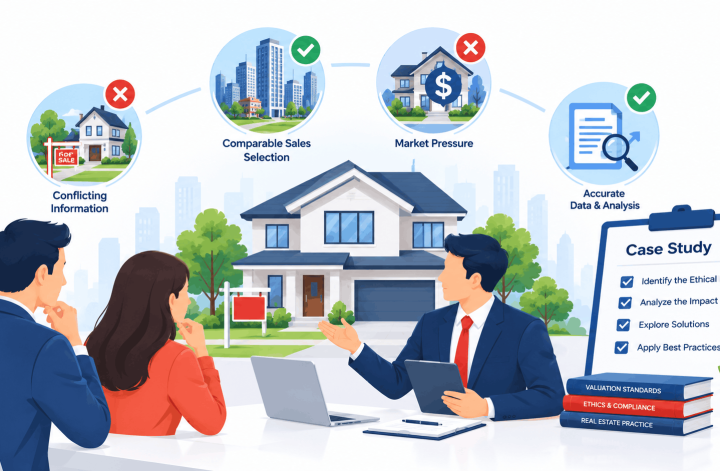
Why Valuation Ethics Matter More Than Most People Realize
Property valuation sits at the center of nearly every real estate transaction. A list price shapes how long a home stays on the market. An opinion of value can decide whether a mortgage closes, whether an estate settles fairly, or whether a seller leaves money on the table. Because so much depends on a single number, the people who produce that number carry a heavy responsibility.
Ethics in valuation is not an abstract topic reserved for licensing exams. It shows up in ordinary decisions: whether to round an estimate upward to win a listing, whether to mention a recent comparable sale that hurts your case, or whether to tell a nervous first-time buyer that a home is overpriced even when they are emotionally attached to it.
This article works through realistic scenarios to show how sound ethical reasoning applies to pricing. The goal is to help homeowners, buyers, investors, and anyone who relies on property values understand what good practice looks like, and to recognize when a pricing recommendation deserves a second look.
What Professional Ethics Means in Property Pricing
Professional ethics in real estate valuation rests on a few core principles. Each one appears repeatedly in the case studies below.
- Objectivity: The conclusion should follow from the evidence, not from what the client hopes to hear.
- Competence: The professional should work only within their training and be honest about the limits of their knowledge.
- Disclosure: Material facts that affect value, including conflicts of interest, should be shared with the people relying on the analysis.
- Confidentiality: Client information should be protected and used only for its intended purpose.
- Independence: Pressure from sellers, brokers, lenders, or other parties should not distort the result.
Many pricing errors are not dramatic fraud. More often they are small compromises that accumulate: an optimistic adjustment here, an omitted sale there. Recognizing these patterns early is the most useful skill a consumer or professional can develop.
Case Study One: The Overpriced Listing Request
A homeowner wants to sell a three-bedroom house in a neighborhood where recent sales have closed between 385,000 and 410,000 dollars. The owner has invested in a renovated kitchen and believes the home deserves 450,000 dollars. An agent is eager to win the listing and is tempted to agree.
The ethical question: Should the agent accept the owner’s number to secure the business?
Sound approach: A professional would present the comparable sales transparently, explain which features the market rewards and which it does not, and show the owner what a 450,000 dollar list price is likely to produce in practice. Overpricing often leads to longer time on the market, price reductions, and a weaker final result. The agent who explains this clearly is serving the seller, even if the seller is initially disappointed.
Lesson: A good valuation professional separates what the client wants from what the evidence supports, then helps the client make an informed choice.
Case Study Two: The Comparable Sale That Hurts the Argument
An appraiser or pricing specialist is reviewing a property. Among the sales data, one recent comparable sold for significantly less because it had a damaged foundation that the seller disclosed. The client would benefit if that sale were left out.
The ethical question: Can a professional omit inconvenient data?
Sound approach: Selective omission distorts the picture. The sale may need an adjustment for condition rather than removal. If it is genuinely not comparable, the reason should be documented clearly. The professional should be able to explain their selection criteria to any reviewer.
Lesson: Adjustments are legitimate. Silent exclusion of unfavorable evidence is not.
Case Study Three: The Anxious First-Time Buyer
A young couple has found a home they love and want to offer 20,000 dollars above the asking price to win a competitive bidding situation. Their agent has reviewed the comparable sales and believes the home is worth roughly the asking price, not more.
The ethical question: Should the agent support an offer they believe overpays, or push back?
Sound approach: The agent should explain the market evidence plainly, including the risk that an overpayment could affect the buyers’ appraisal, their loan-to-value ratio, and their long-term equity. The decision is ultimately theirs, but the buyers deserve a clear view of the tradeoffs before committing. Respecting client autonomy does not mean staying silent about material risks.
Lesson: Honest advice sometimes disappoints people in the short term. It is still the right approach.
Case Study Four: The Conflict of Interest
A broker is asked to provide a valuation for a property that a family member wants to purchase from an estate. The broker stands to earn a commission on the sale, and the estate executor has asked for a quick opinion.
The ethical question: Does the conflict of interest disqualify the broker from giving an opinion?
Sound approach: The conflict should be disclosed immediately. In many cases, the professional should decline the assignment or refer it to someone without a stake in the outcome. If the broker does provide an opinion, the relationship and compensation structure must be stated openly so that the executor can weigh the information accordingly.
Lesson: Disclosure does not fully cure every conflict. When the stakes are high, recusal is often the cleanest path.
Case Study Five: The Rushed Opinion
A client needs a valuation within 24 hours for a refinancing decision. The professional has limited time and little access to recent sales in an unusual property type, such as a converted warehouse loft.
The ethical question: Should the professional deliver a number anyway?
Sound approach: Competence includes knowing when a task falls outside your ability to perform well. The professional can explain the constraints, offer a narrower opinion with clearly stated limitations, or recommend a more suitable specialist. A confident number built on thin data can cause real financial harm.
Lesson: Admitting limits is a professional strength, not a weakness.
Practical Steps for Evaluating Any Valuation
Whether you are a seller reviewing a pricing recommendation or a buyer evaluating an offer, these steps help you judge whether the analysis is trustworthy:
- Ask for the comparable sales. A credible pricing professional will show you the properties used and explain why they were chosen.
- Look for explained adjustments. Differences in square footage, condition, lot size, and location should be quantified and justified.
- Check for disclosed conflicts. Ask whether the person stands to gain from a particular price.
- Notice how the professional handles disagreement. Good advisors welcome questions and will revisit their analysis when new evidence appears.
- Compare more than one opinion. Independent perspectives help reveal outliers and blind spots.
Common Warning Signs of Questionable Pricing
Some patterns deserve caution:
- A price far above or below all recent comparable sales with no clear explanation
- Pressure to decide quickly without time to review the data
- Reluctance to share the reasoning behind a number
- Recommendations that happen to maximize the advisor’s commission
- Vague claims such as “the market will support it” without supporting evidence
Noticing these signals does not automatically mean wrongdoing, but it is a reason to ask more questions.
How Certified Professionals Approach Ethical Pricing
Professional certification can help consumers identify pricing specialists who have committed to standards. C-REPS (Certified Real Estate Pricing Specialists) is a network of licensed agents and brokers who complete specialized training, pass certification exams, meet performance requirements, and follow a professional code of ethics through the National Association of BPO Professionals (NABPOP) certification program.
Because C-REPS professionals are active agents and brokers rather than appraisers, they bring local market knowledge about what buyers are willing to pay today. Membership in a collaborative network also means that clients can draw on broader expertise when a situation calls for it. Certification does not replace your own judgment, but it gives you a starting point for finding professionals held to higher standards than the average agent.
If you are looking for a pricing professional, you can ask any candidate how they handle the situations described in this article. Their answers will tell you a great deal about their approach.
Frequently Asked Questions
What are ethics case studies in real estate valuation?
Ethics case studies are realistic scenarios that show how professionals should handle pricing decisions when competing interests, incomplete data, or pressure are involved. They help students, consumers, and practitioners understand what responsible valuation looks like in practice.
Why does ethics matter in property valuation?
Property values affect listing strategies, loan approvals, tax assessments, estate settlements, and purchase decisions. A distorted valuation can cost people money, cause legal problems, or undermine trust in the market.
How can I tell if a home valuation is honest?
Look for transparent comparable sales, clearly explained adjustments, and a willingness to discuss limitations. Be cautious of prices that are far outside the data without explanation, or advisors who avoid questions about their own incentives.
Should I trust a real estate agent’s price opinion?
An agent’s price opinion can be valuable, especially when it is backed by recent local data and disclosed clearly. Compare it with other sources and ask how the figure was derived before relying on it.
What is a conflict of interest in real estate pricing?
A conflict of interest exists when a professional has a personal or financial stake in the outcome, such as earning a commission from a sale they are valuing. Conflicts should be disclosed, and in some situations the professional should step aside.
What should I do if I suspect a valuation was manipulated?
Document your concerns, request the underlying data, and seek a second opinion from an independent professional. If you believe misconduct occurred, you may be able to report it to the relevant licensing authority in your region.
Are certified pricing specialists more reliable?
Certification indicates that a professional has completed training, passed examinations, and agreed to a code of ethics. It does not guarantee perfect results, but it provides a useful signal when comparing candidates. C-REPS professionals, for example, complete NABPOP certification and follow a professional code of ethics.
How often should I review my property’s value?
Many homeowners review value annually or when major market changes occur, such as shifts in interest rates or local sales activity. Reviewing more often can help when you are planning a sale, refinance, or purchase.
Continuing Education for C-REPS Professionals: Staying Current in Your Field

Earning the C-REPS designation signals that you have invested in pricing expertise. Keeping that expertise sharp is a separate task. Local markets shift, buyer expectations change, lending conditions move, and the tools agents use to analyze sales data keep improving. A pricing method that was excellent three years ago may now miss important signals.
This guide explains why continuing education matters for C-REPS professionals, how ongoing learning fits into the designation’s broader obligations, and how to build a professional development plan you can sustain. Because requirements, credit counts, and deadlines can change, treat the specifics here as a framework and confirm current rules with the certifying organization and your state licensing authority.
Why Continuing Education Matters for C-REPS Professionals
Accurate pricing depends on current information. A comparable sale from eighteen months ago may still be useful, but only if you understand how the market has moved since then. Continuing education keeps your judgment calibrated to present conditions rather than to the conditions you studied when you first earned the credential.
Pricing Is a Moving Target
Buyers decide what they are willing to pay based on financing costs, inventory levels, neighborhood trends, and their own sense of urgency. Those forces change constantly. Professionals who keep learning are better positioned to explain why a home that would have sold quickly last spring now needs a different price range, or why a neighborhood that looked steady is starting to soften.
Credibility Depends on Current Knowledge
Clients rarely ask about a credential’s history. They ask whether you understand their market today. A C-REPS professional who can discuss recent shifts in days on market, price reductions, and buyer behavior sounds more credible than one who relies on a training binder from years ago. Continuing education turns the designation into an ongoing practice rather than a line on a business card.
How Continuing Education Fits Into the C-REPS Designation
C-REPS professionals are trained, tested, and certified through the National Association of BPO Professionals (NABPOP) certification program. The designation asks holders to complete specialized training, pass certification exams, meet performance requirements, maintain membership, and follow a professional code of ethics. Continuing education supports each of those obligations because it keeps your training current and your practice consistent with the program’s standards.
It helps to separate two kinds of requirements that often get mixed together:
- State licensing requirements: Your real estate license almost certainly carries its own continuing education obligations, set by your state’s real estate commission or licensing board.
- Program obligations: The C-REPS program may set expectations for membership, performance, and professional conduct that go beyond the state minimum.
Both matter. Meeting one does not automatically satisfy the other, so review each separately.
Understanding CE Requirements
Continuing education rules vary considerably by state. Some states require a fixed number of hours every renewal cycle, some specify required topics such as fair housing or ethics, and some have different rules for brokers and salespeople. Program-level expectations may add another layer.
State License Continuing Education
Start with your state real estate commission. Look for answers to these questions:
- How many hours of continuing education does my license renewal require?
- Are specific topics mandatory, such as ethics, fair housing, or agency law?
- Which providers are approved to offer qualifying courses?
- What is my renewal date, and what happens if I miss it?
Keep your certificates of completion in a single folder, digital or physical, so you can prove completion quickly if your state audits records.
Program-Level Obligations
For the C-REPS designation, confirm with NABPOP or the official program channel what ongoing expectations apply. Ask about membership renewal timing, any performance benchmarks you must maintain, and whether additional training or refresher content is expected over time. Get the answers in writing where possible.
The table below summarizes how these two layers typically differ. The specifics for your situation should come from your own state and the program’s current materials.
| Consideration | State License CE | C-REPS Program Expectations |
| Who sets the rules | State real estate commission or licensing board | National Association of BPO Professionals (NABPOP) |
| Primary purpose | Protect consumers and maintain licensing standards | Maintain designation standards and professional pricing practices |
| Typical structure | Required hours, sometimes with mandatory topics | Membership, performance, and ethics expectations |
| Renewal trigger | License renewal date | Membership and program renewal timing |
| Where to verify | State licensing website | Official program materials and candidate or member resources |
Types of Learning That Keep Pricing Skills Sharp
Not all continuing education is equally useful for a pricing specialist. Courses that strengthen your analytical skills and ethical judgment tend to have the greatest impact on daily practice. Consider building your learning around these areas:
- Market analysis refreshers: Deepen your understanding of how to read absorption rates, inventory trends, and price reduction patterns in your own territory.
- Adjustment methodology: Revisit how you make adjustments for condition, lot size, updates, and location, especially when comparables are imperfect.
- Local regulation and disclosure: Stay current on disclosure rules, agency obligations, and any local ordinances that affect listing practices.
- Data and technology: Learn how new tools can help you organize sales data, though always verify outputs against your own analysis.
- Ethics and professional conduct: Revisit the code of ethics periodically, particularly around conflicts of interest and pricing candor with sellers.
- Client communication: Practice explaining pricing rationale in plain language, since accuracy only helps clients who understand it.
A useful rule is to ask whether a course will change a specific decision you make in the next thirty days. If the answer is yes, it is likely worth your time.
Building a Yearly Professional Development Plan
Continuing education works best when it is planned rather than squeezed in before a renewal deadline. A simple annual plan keeps you on track without overwhelming your schedule.
Set a Quarterly Review Rhythm
Schedule a short review every three months. During each review, check three things:
- Which required hours or topics you have completed and which remain
- Whether your pricing practice has shown any gaps recently, such as listings that sat longer than expected or offers that differed sharply from your estimate
- Which upcoming course or resource best addresses those gaps
Fifteen minutes each quarter is usually enough. The goal is to catch problems early rather than discover them during renewal week.
Track Credits and Deadlines in One Place
Maintain a single record that lists each course, provider, completion date, hours earned, and the requirement it satisfies. Add renewal dates for your license and any program membership. Set reminders at least sixty days before each deadline, so you have time to fix a shortfall without rushing.
Practical Example: Daniel’s Mid-Career Refresh
Daniel has been a licensed agent for nine years and earned the C-REPS designation early in his career. He noticed that several recent listings were priced accurately on paper but took longer to sell than his projections suggested. Rather than assume the market had simply turned against him, he decided to examine his process.
Daniel built a simple plan. In the first quarter, he completed a state-required course on disclosure updates, which he had been postponing. In the second quarter, he took an advanced course on adjustment methodology and reviewed his last twelve listings, noting where his adjustments had been too generous or too conservative. In the third quarter, he attended a local market briefing hosted by his brokerage and began logging price reductions in his neighborhoods weekly.
By the end of the year, Daniel had not only met his renewal requirements but also changed his pricing conversations. He now shows sellers a short table of recent price reductions alongside his comparable analysis, which helps them understand why a range makes more sense than a single figure. The learning did not replace his training. It made the training useful again.
Common Mistakes to Avoid
Many professionals struggle with continuing education for predictable reasons. Watch for these patterns:
- Waiting until renewal week. Rushed courses rarely produce lasting understanding.
- Choosing courses only for convenience. Quick credits may satisfy a requirement without strengthening your practice.
- Ignoring program obligations. State compliance is necessary, but it may not cover everything the designation expects.
- Treating training as a one-time event. Pricing knowledge decays without regular use and refreshers.
- Failing to document completion. Missing certificates can create serious problems during an audit.
Frequently Asked Questions
Are C-REPS professionals required to complete continuing education?
Your state real estate license almost certainly requires continuing education to renew. The C-REPS program may also set ongoing expectations for membership and performance. Check both your state commission and the official program materials.
How many continuing education hours do C-REPS professionals need?
The number depends on your state’s licensing rules and any program requirements. It is not safe to assume a fixed number, so confirm the current figure with the appropriate authority before planning your schedule.
Can continuing education courses count toward both state and program requirements?
Sometimes, but not always. Each requirement may have different approved content or provider rules. Confirm acceptance in writing before relying on a course for both purposes.
What topics are most useful for pricing specialists?
Courses on market analysis, adjustment methodology, local disclosure rules, ethics, and client communication tend to have the most direct impact on pricing practice.
How often should I review my CE progress?
A quarterly review works well for most professionals. It gives you time to adjust before renewal deadlines approach.
What happens if I miss a continuing education deadline?
Consequences vary by state and by program. Missing a license-related deadline can lead to renewal penalties or a lapse in licensing. Contact your state commission promptly if you fall behind.
Do I need to keep records of my continuing education?
Yes. Keep certificates of completion and a summary log for each course. Records help you prove compliance and make renewal much simpler.
Is continuing education worth the time and cost?
For most professionals, yes, particularly when courses are chosen to address real gaps in practice. Measure value by whether the learning changes how you price, advise, and communicate with clients.
Becoming a C-REPS Certified Professional: A Step-by-Step Guide
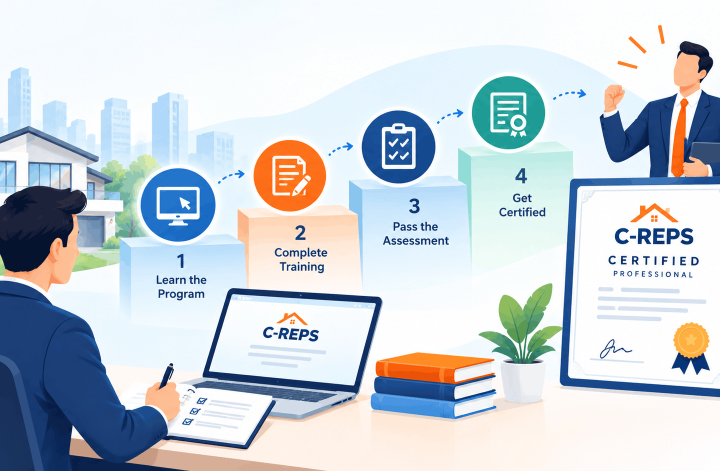
Real estate professionals who want to stand out in a crowded market often look for credentials that signal genuine expertise. The C-REPS designation, short for Certified Real Estate Pricing Specialists, is one of those credentials. It is built around accurate property pricing and local market knowledge, and it asks its holders to meet a higher professional standard than many agents are held to.
This guide walks through what the designation involves, who it is designed for, and the general path toward earning it. Because certification requirements, fees, and program details can change, treat this as an orientation and confirm current specifics with the certifying organization before you commit time or money.
What Is the C-REPS Designation?
C-REPS professionals are active real estate agents and brokers who have completed specialized training in property pricing, passed certification testing, and agreed to follow a professional code of ethics. The designation is administered through the National Association of BPO Professionals (NABPOP) certification program, according to the program materials that describe it.
The core idea is straightforward. Pricing a home well requires more than comparing a few recent sales. It requires understanding what buyers are actually willing to pay in a specific neighborhood at a specific moment. C-REPS aims to formalize that skill set.
Who Is the Certification For?
The designation is intended for licensed professionals in the residential real estate field. Typical candidates include:
- Active real estate agents who want deeper pricing expertise
- Brokers who oversee teams and want a structured, credentialed standard for their agents
- Agents committed to continuing education and long-term professional development
- Professionals who prefer working within a collaborative network rather than as solo practitioners
The designation is not a substitute for an appraisal license. C-REPS professionals are agents and brokers, and the credential reflects their pricing training within that role.
Why Pursue It?
Credentials matter most when they change how clients experience your work. For agents, the C-REPS designation can serve several practical purposes:
- Credibility with sellers: Sellers evaluating listing agents often look for evidence of pricing discipline.
- Differentiation: In markets with many new agents, a specialized credential can help you explain why your approach is different.
- Structured learning: Formal training gives you a repeatable method rather than relying only on instinct.
- Network access: The collaborative model means your clients may benefit from a wider set of certified colleagues.
The designation is most valuable when you use it well. Simply displaying a credential without applying the training rarely changes outcomes for clients.
Step-by-Step: How to Become a C-REPS Certified Professional
The exact steps and requirements should be confirmed with the certifying organization, but the general pathway usually follows this sequence.
Step 1: Confirm You Meet the Baseline Eligibility
Before enrolling, verify that you hold an active real estate license in your state and are in good standing. Certification programs of this type generally assume that candidates are already practicing professionals rather than students.
Step 2: Review the Program Requirements
Request the current candidate handbook or requirements document from NABPOP or the official C-REPS program channel. Look for details on:
- Training hours and format (online, in person, or blended)
- Exam structure, passing standards, and retake policies
- Fees and renewal costs
- Membership obligations and performance expectations
- The code of ethics you will be asked to accept
Step 3: Complete the Specialized Training
The training component is designed to build your pricing methodology. Expect material covering market analysis, comparable property evaluation, adjustments for property differences, and how local conditions affect value. Schedule training in blocks you can actually finish, and take notes you can apply to your own listings and buyer consultations.
Step 4: Prepare for and Pass the Certification Exam
Treat the exam as a test of applied judgment rather than memorization. Practical preparation includes:
- Reviewing the training materials in the order they were presented
- Working through sample pricing scenarios using recent sales in your own market
- Explaining your reasoning out loud, as you would to a seller
- Scheduling the exam only after you consistently perform well on practice material
Step 5: Meet Performance and Membership Requirements
Certification is not a one-time event. The designation typically requires you to maintain membership and meet any performance standards set by the program. Keep records of your activity, client outcomes where permitted, and continuing education credits so renewal is straightforward.
Step 6: Commit to the Code of Ethics
Certified professionals agree to a code of ethics. Read it carefully before you sign. The standard usually covers honesty in pricing, disclosure of conflicts, and fair treatment of clients and colleagues.
Step 7: Maintain Your Designation
Plan for renewal from the start. Set calendar reminders for membership dates and continuing education deadlines, and budget for associated costs.
Comparison: C-REPS Versus Standard Agent Credentials
| Factor | Standard Agent Practice | C-REPS Certified Professional |
| Pricing training | Often learned on the job | Formal, structured training |
| Testing | Licensing exam only | Additional certification exam |
| Ethical commitment | State license requirements | Program code of ethics plus licensing rules |
| Network | Typically independent | Collaborative professional network |
| Ongoing obligations | License renewal | License renewal plus program membership and standards |
This comparison is general. Requirements vary by state and by program, so verify details directly.
Practical Example
Consider an agent named Maria who has been licensed for four years and frequently loses listings because sellers feel her price recommendations are guesses. She decides to pursue the designation. Over several months, she completes the training, builds a habit of documenting every comparable sale she uses, and practices explaining her adjustments to a friend who plays the role of a skeptical seller.
When Maria meets her next prospective seller, she walks through a written pricing analysis that shows each comparable, the reasoning behind each adjustment, and the range of likely outcomes. The seller is not simply impressed by a credential. The seller understands how Maria reached her number, which is the real advantage.
Frequently Asked Questions
What does C-REPS stand for?
C-REPS stands for Certified Real Estate Pricing Specialists. It is a designation for active real estate agents and brokers who complete specialized pricing training and certification.
Who can become a C-REPS professional?
The designation is generally open to licensed real estate agents and brokers. It is not intended for appraisers, who follow a separate licensing track.
Who administers the C-REPS certification?
According to the program materials provided, certification is run through the National Association of BPO Professionals (NABPOP). Confirm current administration details with the organization directly.
How long does the certification process take?
Timelines vary based on training format, study pace, and exam scheduling. Most candidates should plan for several months of preparation, but confirm the current program timeline before committing.
Does C-REPS certification replace a real estate license?
No. The designation builds on an active real estate license. You must remain licensed in your state to hold it.
Is C-REPS certification worth it for a new agent?
It depends on your goals and market. New agents may benefit from the structured training, but should first build foundational experience and confirm the cost and time investment fits their business plan.
How do I know if a C-REPS professional is legitimate?
Check the program’s official directory or ask the agent for their certification details and verification source. Legitimate professionals should be willing to share this information.
Does the designation need to be renewed?
Certification generally requires ongoing membership and standards compliance. Review the renewal requirements in the official program materials.
How Modern Technology Helps C-REPS Agents Serve You Better

Home pricing used to depend heavily on an agent’s memory, a stack of printed listings, and a few phone calls. Today, process automation handles much of the data gathering and organization behind a pricing opinion, which leaves professionals more time to do what technology cannot: interpret what buyers are actually willing to pay in a specific neighborhood, on a specific street, this month. For homeowners, the result is a more accurate price and a more efficient path to closing.
This guide explains how modern tools support real estate valuation accuracy, where human expertise remains essential, and what questions to ask your agent so you can judge the quality of their process for yourself.
What Automation Means in Real Estate Valuation
Process automation in real estate refers to software that performs repetitive research and data tasks without manual effort at every step. In pricing work, that can include pulling recent sales records, matching property features, flagging listings that have changed status, and organizing the results into a clear comparison.
Automation does not decide what a home is worth on its own. It supplies a faster, more complete set of inputs. The professional then reviews those inputs, removes irrelevant data, and applies local judgment.
Automation Versus Manual Research
Manual research relies on one person checking records, sites, and notes one property at a time. That approach works, but it is slow, and it is vulnerable to small errors such as a missed sale, an outdated status, or a mismatch in square footage that quietly distorts a comparison.
Automated workflows reduce those risks by standardizing how data is collected. The same fields are captured for every comparable property, and the same filters are applied consistently. The agent’s role shifts from data clerk to analyst.
Why Valuation Accuracy Matters to Your Bottom Line
A home priced too high may sit on the market, collect fewer showings, and eventually sell for less than it would have with a realistic starting price. A home priced too low leaves money on the table. Either outcome can cost a seller thousands of dollars, and it can cost a buyer the confidence to make a competitive offer.
Accuracy matters for buyers too. An offer based on an inflated sense of value can strain a budget, while an offer based on a thorough analysis gives a buyer a defensible reason for the number they propose.
The Role of Market Timing
Real estate markets shift. Interest rates, inventory levels, and seasonal patterns all influence what buyers will pay. A valuation built on sales from six months ago may no longer reflect current demand. Automated tracking helps professionals spot these changes sooner, so the analysis reflects today’s conditions rather than last season’s.
How Process Automation Improves Efficiency
Efficiency gains are often the first benefit people notice, but they matter because they affect quality. When an agent spends less time on routine tasks, more time remains for property walkthroughs, neighborhood research, and client conversations.
Faster Data Gathering
Pulling records from multiple sources used to take hours. Automated systems can collect and refresh that information in minutes, which means an agent can respond to your questions with current data rather than promising to follow up in a few days.
Consistent Comparable Selection
Choosing comparable properties, often called comps, is one of the most important steps in pricing. Automation applies the same criteria to each comp, such as distance, size, age, condition indicators, and recency of sale. Consistency reduces the chance that a favorable comparison is chosen while a less favorable one is ignored.
Quicker Market Updates
When a comparable property sells, is withdrawn, or changes price, an automated system can flag the change. That alert allows the agent to update the analysis promptly and to explain to you what changed and why.
Clearer Reporting
Many automated tools generate organized reports with charts, adjustment notes, and source references. Clear documentation makes it easier for you to understand the reasoning behind a price, ask informed questions, and compare one agent’s analysis with another’s.
Where Human Expertise Still Leads
Technology is powerful, but it has limits. No software can walk through a home and notice that the roof is near the end of its life, that a renovation was done without permits, or that a busy road creates noise at certain hours. These factors affect value, and they require a trained eye.
Local knowledge is equally important. An algorithm may treat two streets as similar because the homes share square footage and build year. An experienced agent knows that one street has a strong school pipeline, a planned transit station, or a history of flooding that buyers take seriously.
Negotiation and communication also depend on people. Pricing advice has to be explained, questioned, and adapted to your goals, whether you want a fast sale, the highest possible price, or a sale that fits a relocation timeline.
C-REPS Professionals and Technology: A Balanced Approach
C-REPS (Certified Real Estate Pricing Specialists) are active real estate agents and brokers, not appraisers. They are trained, tested, and certified through the National Association of BPO Professionals (NABPOP) certification program, which requires specialized training, certification exams, performance requirements, maintained membership, and adherence to a professional code of ethics.
That combination shapes how C-REPS professionals use technology. Automation supplies speed and consistency. Certification and market experience supply judgment. Membership in a collaborative network adds a second perspective when a property or market is unusual.
It is also important to understand what a pricing opinion is. A comparative market analysis (CMA) prepared by a real estate professional is an estimate of value based on recent market activity. A licensed appraisal is a separate service performed by a licensed or certified appraiser, and lenders often require one for mortgage purposes. Knowing which you need helps you set the right expectations.
Comparison: Traditional Pricing Versus Automation-Supported Pricing
| Factor | Traditional Manual Process | Automation-Supported Process with Professional Review |
| Data collection | Manual searches across several sources | Systematic pulls from multiple sources with regular refreshes |
| Speed of updates | Dependent on how often the agent checks | Alerts when comparable properties change status |
| Comparable selection | Varies by individual approach | Applies consistent criteria, then reviewed by the agent |
| Documentation | Often informal or handwritten | Organized reports with supporting data |
| Local judgment | Strong when experienced | Equally strong, supported by better data |
| Risk of missed data | Higher with large data volumes | Lower, though review is still essential |
The most reliable approach combines both columns: technology for thoroughness and an experienced professional for interpretation.
Practical Examples
Examples make the process easier to picture. The scenarios below are illustrative and do not describe any specific transaction.
Home Seller Example
A family preparing to sell a three-bedroom home asks for a pricing analysis. The agent’s automated system gathers recent sales within a defined radius, filters for similar size and age, and flags two nearby homes that were withdrawn from the market this month. The agent reviews the list, removes one comparable that had a major structural issue, and adjusts for a recent kitchen renovation on the seller’s home. The seller receives a clear report explaining why a specific price range is recommended and how it may change if market activity shifts.
Home Buyer Example
A buyer is deciding how much to offer on a townhouse. Rather than relying on the listing price, the agent provides recent sales of similar units, notes how long comparable homes stayed on the market, and explains which features justify a premium and which do not. The buyer makes an offer based on evidence and feels comfortable with the negotiation strategy.
Investor Example
An investor evaluating a rental property wants to know whether the asking price aligns with local values. The agent uses automated tracking to compare recent sales of similar properties, then adds local context about rental demand, vacancy patterns, and planned infrastructure projects. The investor gains a clearer picture of value and a more realistic expectation of returns.
Actionable Steps for Sellers, Buyers, and Owners
Whether you are selling, buying, or simply want to understand your property’s value, these steps will help you make better decisions.
- Ask for the data behind the number. A reputable agent should be able to show you the comparable properties and explain why each one was included or excluded.
- Request a current analysis. Pricing based on sales from several months ago may not reflect today’s market.
- Compare more than one opinion when the stakes are high. Speaking with two qualified professionals can reveal differences in approach and local insight.
- Clarify the purpose of the estimate. A listing price strategy, an offer strategy, and a mortgage appraisal serve different goals.
- Look for a process, not just a promise. Ask how the agent updates data, verifies comparables, and handles unusual properties.
- Keep your property records current. Renovation receipts, permits, and maintenance logs help your agent account for improvements accurately.
Questions to Ask Your Agent About Technology
Asking the right questions reveals how thoughtfully an agent uses tools. Consider asking how often their data is refreshed, which sources they rely on, and how they verify that a comparable property is truly comparable. Ask what they do when automated results conflict with what they see on the ground, and how they explain adjustments to you.
A good answer will emphasize transparency and professional judgment. Be cautious of anyone who promises a precise value without explaining the method behind it.
Frequently Asked Questions
How does automation improve real estate valuation accuracy?
Automation gathers and organizes sales data more quickly and consistently than manual methods. This reduces the chance of missed records, outdated information, and inconsistent comparable selection. Accuracy still depends on professional review, because local conditions and property details require human judgment.
Does automation replace a real estate agent’s pricing expertise?
No. Automation handles data collection and organization, while the agent interprets that data, evaluates property condition, and considers neighborhood factors. The combination of technology and expertise produces more reliable results than either alone.
What is a C-REPS professional?
C-REPS stands for Certified Real Estate Pricing Specialists. These are active real estate agents and brokers who complete specialized training, pass certification exams, meet performance requirements, maintain membership, and follow a professional code of ethics through the NABPOP certification program.
Is a C-REPS pricing analysis the same as an appraisal?
Not exactly. A pricing analysis, such as a comparative market analysis, estimates value based on recent market activity and is prepared by a real estate professional. An appraisal is performed by a licensed or certified appraiser and is often required by lenders for mortgage purposes.
How often should a home’s value be updated?
Values can change with market conditions, so an analysis that is several months old may not reflect current activity. If you are planning to sell or make an offer, request a current analysis close to the time of your decision.
Can technology account for home improvements and condition?
Automated systems can record features you provide, such as square footage, updates, and upgrades. However, condition is best assessed in person. A professional walkthrough allows your agent to verify features and identify issues that data alone would miss.
What should I ask a real estate agent about their pricing process?
Ask where their data comes from, how often it is refreshed, how they select comparable properties, and how they handle unusual homes. Request to see the supporting comparables and ask them to explain any adjustments in plain language.
Will automated pricing tools work well in every neighborhood?
Automation performs best where there is a reasonable volume of recent sales. In unique properties or thin markets, there may be fewer comparables, so professional judgment becomes even more important. A good agent will tell you when the available data is limited.
Working With a C-REPS Professional
Technology is changing how real estate professionals work, but the goal remains the same: helping you make confident decisions about one of the largest financial choices in your life. C-REPS professionals combine certified training, local market knowledge, and modern tools to deliver pricing that reflects what buyers are willing to pay today.
If you are thinking about selling, buying, or understanding the value of your property, consider speaking with a C-REPS professional. Ask to see how their process works, and let the quality of their answers guide your decision.
Data Privacy in Real Estate Transactions: How to Protect Your Personal Information

Buying or selling a home involves more personal information than almost any other financial decision. Within a few weeks, you may share your Social Security number, bank statements, tax returns, employment history, and details about your family and daily routines. Much of that information passes through multiple hands: agents, lenders, title companies, appraisers, inspectors, escrow officers, and sometimes third-party software platforms. Each handoff creates an opportunity for exposure.
This guide explains where your data goes during a real estate transaction, which risks are most common, and what you can do to protect yourself. It is written for home sellers, buyers, and property owners who want to take a careful, informed approach without becoming overwhelmed by technical jargon.
Why Data Privacy Matters More in Real Estate
Real estate is one of the few consumer markets where a single transaction can expose a person’s identity, income, savings, and property ownership all at once. Fraud attempts in this sector are well documented. Criminals have targeted closings by impersonating title companies, sending fake wire instructions, and intercepting email threads between buyers and escrow officers. The Federal Bureau of Investigation has repeatedly warned about business email compromise schemes that target real estate transactions, and the financial losses can be substantial.
Privacy also matters for reasons beyond fraud. Sellers may not want strangers to know when they are leaving a property. Buyers may not want their financial details circulating among parties who have no need to see them. Ownership records are public in most jurisdictions, but the personal documents behind a transaction are not, and they should remain that way.
The Information Involved in a Typical Transaction
Understanding what data is collected is the first step toward protecting it. A typical buyer submits:
- Government-issued identification such as a driver’s license or passport
- Social Security number, used for credit checks and tax reporting
- Pay stubs, W-2 forms, tax returns, and bank statements
- Credit history and credit score information
- Employment verification details
- Gift letters and documentation for down payment sources
A typical seller provides:
- Proof of ownership and property title history
- Mortgage payoff information and loan account numbers
- Identification documents for notarization
- Tax records and homestead filings
- Contact information for tenants or occupants, where relevant
Each category carries a different level of sensitivity, and the right protections depend on which one is involved.
Who Handles Your Data
A real estate transaction typically involves several parties, and each one has a different level of need for your information.
- Your real estate agent needs to know your goals, budget, and timeline. They rarely need your Social Security number or full bank statements.
- Your lender requires comprehensive financial documentation under federal lending rules.
- The title company or escrow officer verifies ownership, runs title searches, and handles funds. They need identification and banking details to complete the closing.
- The appraiser needs access to the property, not your financial records.
- Inspectors and contractors typically need only property access and contact information.
- Transaction platforms and software may store documents in cloud systems that carry their own security practices.
Knowing who needs what allows you to share deliberately rather than sending everything to everyone.
Common Privacy Risks in Real Estate
Wire Fraud and Payment Diversion
This is the most financially damaging threat. A fraudster monitors email traffic, then sends a message that appears to come from the title company or agent with changed wire instructions. A buyer who wires closing funds to the wrong account may lose the entire amount, and recovery is difficult.
Phishing and Impersonation
Emails or text messages that imitate real professionals can request documents, passwords, or payment. These messages often create urgency, such as claiming a deadline is approaching or a fee must be paid immediately.
Unsecured Document Sharing
Sending sensitive files as unencrypted email attachments, or through personal messaging apps, leaves them exposed if an account is compromised. Documents forwarded through multiple inboxes multiply that exposure.
Oversharing During Showings and Open Houses
Sellers sometimes leave personal mail, financial paperwork, prescription bottles, or identifying documents visible during showings. Visitors who sign in at open houses may provide contact details that are later sold to marketing lists.
Public Records and Online Exposure
Property records, sale prices, and owner names are generally public. Combined with social media posts announcing a move or a vacation, this information can reveal when a home is unoccupied.
Practical Steps for Home Sellers
Sellers can reduce exposure without slowing down their sale.
Secure the property before showings. Remove or lock away mail, bills, checkbooks, identification, and prescription medications. Store passports and important papers in a safe or with a trusted family member.
Limit social media activity. Avoid posting about your move date, travel plans, or the new home until after closing.
Share documents through encrypted or access-controlled portals. Ask your agent whether they use a secure transaction platform. If you must send a file by email, confirm the recipient’s address by phone first.
Be selective about open house sign-in. Many sellers use a sign-in sheet that collects only a name and general contact information, without requesting a Social Security number or income details. Dispose of sign-in sheets securely.
Review your agent’s data practices. Ask how they store client files, who has access, and how long records are kept.
Practical Steps for Home Buyers
Buyers face the highest concentration of sensitive requests, so a few habits matter a great deal.
Verify wire instructions by phone before sending any money. Call the title company using a phone number you find independently, such as on their official website or a printed closing document, not a number provided in the same email. Never rely on wire instructions received by email alone.
Provide your Social Security number only when it is required. Lenders and title companies have legitimate uses for it, but agents and inspectors typically do not. Ask why any party needs the number before sharing it.
Use strong, unique passwords and two-factor authentication. Your email account is often the gateway to your transaction. Protect it accordingly.
Confirm the identity of anyone who contacts you. If a person calls claiming to be your lender or closer, hang up and call back using a verified number.
Keep copies of everything. Maintain a secure record of documents you have sent and received, along with dates and recipients.
A Simple Verification Checklist
Before sending funds or sensitive documents, run through these questions:
- Did the request come through a channel I initiated or verified?
- Have I confirmed the wire details by phone using an independently sourced number?
- Does the requested information match what this party actually needs?
- Is there an unusual sense of urgency?
- Is the sender’s email address an exact match to the official domain?
If any answer raises concern, pause and verify before proceeding.
Comparing Secure and Unsecure Document Sharing Methods
| Method | Security Level | Best For | Key Limitation |
| Secure transaction portal | High | Full closing packages, IDs, financial records | Requires account setup |
| Encrypted email | Moderate to high | Individual documents | Depends on recipient setup |
| Standard email attachment | Low | Non-sensitive forms | Easily intercepted or forwarded |
| Text message or messaging app | Low | Scheduling and general updates | Not suitable for personal data |
| Physical delivery with tracking | High | Original signed documents | Slower, less convenient |
Most transactions benefit from a secure portal for anything containing identifiers or financial details.
Questions to Ask Your Real Estate Professional
Asking direct questions is one of the most effective privacy measures you can take. Consider asking:
- How do you store and transmit client documents?
- Do you use a secure transaction management platform?
- Who in your office or network has access to my file?
- How do you handle wire transfer instructions?
- What is your process if a suspicious message is received?
- How long do you retain client records after closing?
A professional who welcomes these questions is usually one who takes data protection seriously.
Understanding Your Legal Protections
Several laws apply to how personal information is handled in real estate. The Gramm-Leach-Bliley Act requires financial institutions, including many mortgage lenders, to explain their information-sharing practices and protect customer data. The Real Estate Settlement Procedures Act governs certain disclosures and closing procedures. State laws may add further requirements for data breach notification and consumer privacy.
These laws provide a baseline, but they do not replace your own vigilance. Ask your lender and title company for their privacy notices, and read them. They describe what information is collected, how it is used, and whether it is shared with third parties.
Why Working With Certified Professionals Helps
Data privacy depends heavily on the people handling your transaction. A poorly trained agent may share documents carelessly or fail to recognize a fraud attempt. Professionals who have completed structured training and certification are generally better equipped to recognize warning signs and follow consistent practices.
C-REPS (Certified Real Estate Pricing Specialists) is a network of licensed agents and brokers who complete specialized training, pass certification exams, meet performance requirements, maintain their membership, and follow a professional code of ethics. Certification through the National Association of BPO Professionals (NABPOP) signals a commitment to professional standards that goes beyond the minimum licensing requirements. Because C-REPS agents work as a collaborative network, clients also benefit from shared knowledge and professional accountability across the group.
Certification does not guarantee that a transaction will be free of risk. However, it does indicate that the professional has been trained and tested, and that they operate under a code of conduct that includes respect for client confidentiality.
Common Mistakes to Avoid
- Trusting an email simply because it looks official. Logos and signatures are easy to copy.
- Sending full financial records when a partial document would suffice. Redact account numbers when possible.
- Discussing wire details over unsecured channels. Confirm by phone.
- Ignoring privacy notices. They contain useful information about data sharing.
- Waiting until after a problem occurs. Set up protections at the start of the process.
What to Do If Your Information Is Compromised
If you suspect your data has been exposed, act quickly.
- Contact your bank and lender immediately, and ask them to flag your accounts.
- Place a fraud alert or credit freeze with the major credit bureaus.
- Notify your real estate agent and title company so they can verify any pending transactions.
- If funds were sent to a fraudulent account, contact your bank right away and report the incident to the FBI’s Internet Crime Complaint Center at ic3.gov.
- Document everything, including emails, phone numbers, and timestamps.
- Consider consulting an attorney if your losses are significant.
Speed matters. Wire transfers can sometimes be recalled if the fraud is reported within hours.
Frequently Asked Questions
Is it safe to send my Social Security number to my real estate agent?
Generally, no. Agents typically do not need your Social Security number. Lenders and title companies may require it for credit checks and tax reporting, so ask who needs it and why before providing it.
How can I tell if wire instructions are fraudulent?
Be cautious of any change to previously provided wire details, especially if they arrive by email. Call the title company using a phone number from an official source, not from the email, and confirm the details verbally before sending money.
Can someone find out I’m selling my home?
Your listing is public, so the sale itself is visible. However, you can limit personal details by avoiding social media posts about your moving plans and by keeping sensitive documents out of sight during showings.
Do open house sign-in sheets put my privacy at risk?
They can. Sign-in sheets that request excessive information may be used for marketing or sold to third parties. Look for sheets that collect only essential contact details, and ask the listing agent how the information will be used.
What should I do if I think I sent money to a scammer?
Contact your bank immediately and request a wire recall. Report the incident to the FBI’s Internet Crime Complaint Center at ic3.gov and to your local law enforcement. Acting within hours improves the chances of recovery.
Are digital transaction platforms secure?
Reputable platforms use encryption, access controls, and audit trails. Still, security depends on how the platform is configured and how users manage their logins. Choose platforms with clear security policies and enable two-factor authentication.
Do I need an attorney to protect my data during a sale?
An attorney is not required for routine privacy protection, but one can be valuable if you encounter a breach, a disputed transaction, or unclear contractual obligations. Many states require attorney involvement in closings, which provides an additional layer of review.
How long do real estate professionals keep my records?
Retention periods vary by state, licensing requirements, and the type of document. Ask your agent, lender, and title company about their retention policies and how they dispose of records when they are no longer needed.
Virtual Property Tours and Remote Valuations: Post-Pandemic Best Practices
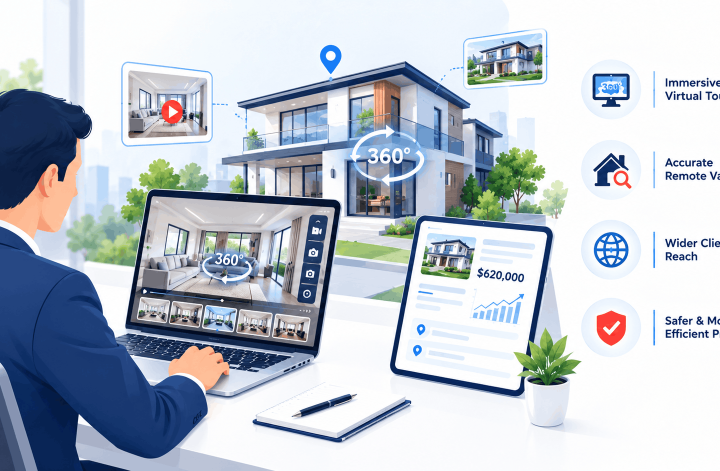
Before 2020, touring a home meant booking time off, driving across town, and walking through rooms with an agent. Valuations meant an in-person visit, a printed comparable sales sheet, and a long wait for a number. The pandemic changed that routine almost overnight. Today, many buyers begin their search online, many sellers receive a price opinion without a single stranger walking through their front door, and many transactions include a mix of digital and physical steps.
This shift is here to stay, but it has also created confusion. Some tools are excellent, others are little more than automated guesses, and it can be hard to tell which is which. This guide explains what virtual property tours and remote valuations actually do, where they work well, where they fall short, and how to use them responsibly whether you are buying, selling, or simply trying to understand what your home is worth.
What Is a Virtual Property Tour?
A virtual property tour is a digital representation of a home that lets viewers move through the space without visiting in person. The format varies widely:
- 3D walkthroughs built from a scan or series of photos, letting viewers move from room to room
- Video tours recorded by an agent or homeowner, often narrated
- Live video tours where an agent walks the property in real time while the viewer watches from a phone or laptop
- Interactive floor plans that show room dimensions, layout, and sometimes furniture placement
- 360-degree photography that lets viewers look around each room from a fixed point
Each format serves a different purpose. A 3D walkthrough helps a buyer understand flow and layout. A live video tour lets a buyer ask questions and request a closer look at a specific wall, ceiling, or window. An interactive floor plan is especially helpful when a buyer is comparing several properties and needs to judge whether a sofa, bed, or dining table will fit.
Where Virtual Tours Work Best
Virtual tours are most useful in a few situations:
- Screening properties before committing time to in-person visits
- Relocating buyers who cannot easily travel to view homes
- Investors evaluating several properties across different markets
- Busy professionals who need to narrow a list quickly
- Sellers who want to show their home to a wider audience early on
Where Virtual Tours Fall Short
Virtual tours cannot fully replace an in-person visit. They often fail to show:
- Smells, humidity, and noise levels
- The condition of the roof, foundation, plumbing, and electrical systems
- Neighborhood conditions at different times of day
- Natural light at the hours you would actually live there
- Subtle signs of water damage, pests, or poor construction
A polished tour can make a property look better than it is. Treat virtual tours as a first filter, not a final verdict.
What Is a Remote Valuation?
A remote valuation is an estimate of a property’s market value made without a full physical inspection by the person producing it. Depending on the provider and the method, a remote valuation might rely on:
- Recent comparable sales in the area
- Public records such as tax assessments and deed transfers
- Photographs or a homeowner-submitted questionnaire
- Automated valuation models (AVMs) that apply statistical formulas to property data
- A licensed professional reviewing the property’s features and local conditions
These approaches differ significantly in accuracy. An automated model that uses only public records may miss a recent renovation, a damaged roof, or a desirable corner lot. A trained agent who knows the local market, reviews current listings, and understands what buyers are willing to pay right now can often catch those details.
The Difference Between an Estimate and a Professional Opinion
It helps to understand what you are actually receiving. An automated estimate is a data-driven number. A professional price opinion, or broker price opinion (BPO), is a judgment based on comparable sales, active listings, expired listings, and local expertise. Neither is a formal appraisal, which is a licensed appraiser’s report prepared for lending or legal purposes.
Knowing the difference matters. If you are planning to list your home, an online estimate can give you a starting range, but it should not be the only input into your pricing decision. If you are a buyer, an automated figure can flag a property that seems overpriced, but it should be followed by a closer review of the comparables and the home’s actual condition.
The Post-Pandemic Hybrid Approach
The most effective approach for most people is neither fully digital nor fully in person. It is a hybrid model that uses technology to do what it does well and reserves physical visits for decisions that require them.
Here is how a typical hybrid process can work for a buyer:
- Start with virtual tours to build a shortlist of properties that match your needs and budget.
- Review remote valuations or market analysis to understand whether asking prices align with recent sales.
- Schedule in-person visits only for the homes that remain strong candidates.
- Request a second look at key areas, such as the basement, roof access, or utility room, during the in-person visit.
- Commission a licensed inspection and appraisal before making a final offer or committing to financing.
For a seller, the hybrid path often looks like this:
- Request a remote valuation to establish a preliminary price range.
- Compare the estimate against recent local sales and your agent’s market analysis.
- Prepare the home using advice from a professional walkthrough, which may be virtual or in person.
- Create a high-quality virtual tour to attract early interest from out-of-town and online buyers.
- Confirm final pricing in person before listing, so the number reflects the home’s actual condition.
The hybrid approach saves time without sacrificing the judgment that only a physical or professional review can provide.
How to Evaluate a Virtual Tour
Not all virtual tours are created equal. When you encounter one, ask yourself these questions:
- Is the entire property covered? Look for basements, garages, attics, and outdoor spaces, not just the most photogenic rooms.
- Is the image quality clear? Blurry or heavily filtered images can hide defects.
- Are the measurements accurate? Confirm dimensions against the floor plan if you plan to bring furniture.
- Is the date current? Tours of a home that has been renovated, staged differently, or sold and relisted may no longer reflect reality.
- Who created it? A tour from the listing agent is marketing. A tour from an independent professional may offer more neutral context.
If something seems missing or unclear, ask for a live video walkthrough before moving forward.
How to Evaluate a Remote Valuation
A remote valuation is only as good as the data and reasoning behind it. Before relying on one, consider the following:
- What data was used? Ask which comparable sales were considered, how recent they are, and how similar they are to your home in size, age, condition, and location.
- Was the property’s condition considered? A valuation that ignores a new roof, a kitchen renovation, or deferred maintenance is incomplete.
- How current is the market information? Prices can shift within a few months, especially in fast-moving or seasonal markets.
- Does the provider explain its reasoning? A good valuation includes adjustments and context, not just a single number.
- Is the provider qualified? Find out whether the person preparing the opinion is licensed, certified, and accountable to professional standards.
Be cautious of any valuation that promises an exact figure with no explanation, or that pushes you toward a quick decision.
Choosing the Right Professional
Whether you are working with a real estate agent, broker, or valuation specialist, credentials and conduct matter. The industry includes a wide range of practitioners, and the quality of advice varies considerably.
When evaluating a professional, consider these factors:
- Certification and training. Ask whether the person has completed specialized training and passed a certification process.
- Local market knowledge. A professional who knows your neighborhood can explain why two similar homes sold for very different prices.
- Transparency. A trustworthy professional will explain how they reached their conclusions and will tell you when data is limited.
- Professional network and standards. Membership in an organization with a code of ethics and ongoing education requirements offers an additional layer of accountability.
- Focus on accuracy over speed. Be wary of anyone who pressures you to decide quickly or who suggests a price that seems designed to win your business rather than reflect the market.
C-REPS (Certified Real Estate Pricing Specialists) is one example of a network built around these principles. Its members are active real estate agents and brokers, not appraisers, who complete training, pass certification exams, meet performance requirements, maintain membership, and follow a professional code of ethics through the National Association of BPO Professionals (NABPOP) certification program. Members combine that training with a working understanding of what buyers are willing to pay in their local markets today. Because C-REPS professionals work as part of a collaborative network, clients who work with one member can draw on the broader group’s expertise. You can learn more about the network and its standards at the official C-REPS website, and you can verify a professional’s standing directly with the organization.
Practical Examples
Example 1: The relocating buyer. A couple moving from another state uses virtual tours to narrow twelve homes down to four. They then schedule a two-day trip to visit those four in person, returning with a clear favorite. Without the virtual screening, they would have needed several extra trips.
Example 2: The cautious seller. A homeowner requests three remote valuations and receives estimates ranging from $310,000 to $365,000. Rather than picking the highest number, she asks each provider to explain their comparables. She discovers that one estimate ignored a recently finished basement, while another relied on sales from a different school district. After a professional walkthrough, she sets a list price of $342,000, supported by documented comparable sales.
Example 3: The investor. An investor evaluating rental properties uses interactive floor plans and remote valuations to screen fifty listings. He shortlists six for in-person inspection, where he discovers a foundation issue that the virtual tour did not show. He avoids a costly purchase by combining both methods.
Common Mistakes to Avoid
- Relying on a single estimate. Compare at least two or three sources before drawing conclusions.
- Skipping the inspection. No virtual tool replaces a licensed home inspection.
- Ignoring recent changes. Ask whether the home has been renovated, damaged, or re-staged since the tour was recorded.
- Confusing marketing with evidence. Listing photos are designed to sell. Look for factual details in the data.
- Overlooking local context. School boundaries, flood zones, planned developments, and neighborhood trends all affect value.
- Rushing the decision. Quick decisions are rarely the best decisions in real estate.
Frequently Asked Questions
Are virtual property tours accurate?
Virtual tours are generally accurate for layout, finishes, and room sizes when they are recent and professionally created. They are less reliable for condition issues such as moisture, structural problems, or noise. Always confirm important details in person.
How accurate is a remote valuation?
Accuracy depends on the data and method used. Automated estimates can be useful for a rough range but may miss renovations or unique features. A professional opinion that includes comparable sales and local context is usually more reliable.
Can I sell my home without any in-person visits?
Some parts of the process can be handled remotely, including initial pricing and marketing. However, most sales still require in-person steps such as inspections, appraisals, and final walkthroughs before closing.
Is a remote valuation the same as an appraisal?
No. A remote valuation is typically a professional opinion or automated estimate used for pricing decisions. A formal appraisal is prepared by a licensed appraiser and is often required by lenders.
How do I know if a virtual tour is misleading?
Look for outdated photos, missing areas, distorted measurements, or tours that avoid certain rooms. If anything seems unclear, request a live video walkthrough or an in-person visit.
What should I ask a professional before accepting a valuation?
Ask which comparable sales were used, how recent they are, how the property’s condition was considered, and what adjustments were made. Also ask about their credentials and how they stay current with local market changes.
Are remote valuations safe for privacy?
Share only the information you are comfortable providing. Reputable providers explain what data they collect and how it is used. Review privacy policies before submitting personal details.
Should I use technology or a human professional?
Use both. Technology is excellent for speed and screening, while a trained professional provides judgment, local context, and accountability. The hybrid approach combines the strengths of each.