Buying or selling a home involves more personal information than almost any other financial decision. Within a few weeks, you may share your Social Security number, bank statements, tax returns, employment history, and details about your family and daily routines. Much of that information passes through multiple hands: agents, lenders, title companies, appraisers, inspectors, escrow officers, and sometimes third-party software platforms. Each handoff creates an opportunity for exposure.
This guide explains where your data goes during a real estate transaction, which risks are most common, and what you can do to protect yourself. It is written for home sellers, buyers, and property owners who want to take a careful, informed approach without becoming overwhelmed by technical jargon.
Why Data Privacy Matters More in Real Estate
Real estate is one of the few consumer markets where a single transaction can expose a person’s identity, income, savings, and property ownership all at once. Fraud attempts in this sector are well documented. Criminals have targeted closings by impersonating title companies, sending fake wire instructions, and intercepting email threads between buyers and escrow officers. The Federal Bureau of Investigation has repeatedly warned about business email compromise schemes that target real estate transactions, and the financial losses can be substantial.
Privacy also matters for reasons beyond fraud. Sellers may not want strangers to know when they are leaving a property. Buyers may not want their financial details circulating among parties who have no need to see them. Ownership records are public in most jurisdictions, but the personal documents behind a transaction are not, and they should remain that way.
The Information Involved in a Typical Transaction
Understanding what data is collected is the first step toward protecting it. A typical buyer submits:
- Government-issued identification such as a driver’s license or passport
- Social Security number, used for credit checks and tax reporting
- Pay stubs, W-2 forms, tax returns, and bank statements
- Credit history and credit score information
- Employment verification details
- Gift letters and documentation for down payment sources
A typical seller provides:
- Proof of ownership and property title history
- Mortgage payoff information and loan account numbers
- Identification documents for notarization
- Tax records and homestead filings
- Contact information for tenants or occupants, where relevant
Each category carries a different level of sensitivity, and the right protections depend on which one is involved.
Who Handles Your Data
A real estate transaction typically involves several parties, and each one has a different level of need for your information.
- Your real estate agent needs to know your goals, budget, and timeline. They rarely need your Social Security number or full bank statements.
- Your lender requires comprehensive financial documentation under federal lending rules.
- The title company or escrow officer verifies ownership, runs title searches, and handles funds. They need identification and banking details to complete the closing.
- The appraiser needs access to the property, not your financial records.
- Inspectors and contractors typically need only property access and contact information.
- Transaction platforms and software may store documents in cloud systems that carry their own security practices.
Knowing who needs what allows you to share deliberately rather than sending everything to everyone.
Common Privacy Risks in Real Estate
Wire Fraud and Payment Diversion
This is the most financially damaging threat. A fraudster monitors email traffic, then sends a message that appears to come from the title company or agent with changed wire instructions. A buyer who wires closing funds to the wrong account may lose the entire amount, and recovery is difficult.
Phishing and Impersonation
Emails or text messages that imitate real professionals can request documents, passwords, or payment. These messages often create urgency, such as claiming a deadline is approaching or a fee must be paid immediately.
Unsecured Document Sharing
Sending sensitive files as unencrypted email attachments, or through personal messaging apps, leaves them exposed if an account is compromised. Documents forwarded through multiple inboxes multiply that exposure.
Oversharing During Showings and Open Houses
Sellers sometimes leave personal mail, financial paperwork, prescription bottles, or identifying documents visible during showings. Visitors who sign in at open houses may provide contact details that are later sold to marketing lists.
Public Records and Online Exposure
Property records, sale prices, and owner names are generally public. Combined with social media posts announcing a move or a vacation, this information can reveal when a home is unoccupied.
Practical Steps for Home Sellers
Sellers can reduce exposure without slowing down their sale.
Secure the property before showings. Remove or lock away mail, bills, checkbooks, identification, and prescription medications. Store passports and important papers in a safe or with a trusted family member.
Limit social media activity. Avoid posting about your move date, travel plans, or the new home until after closing.
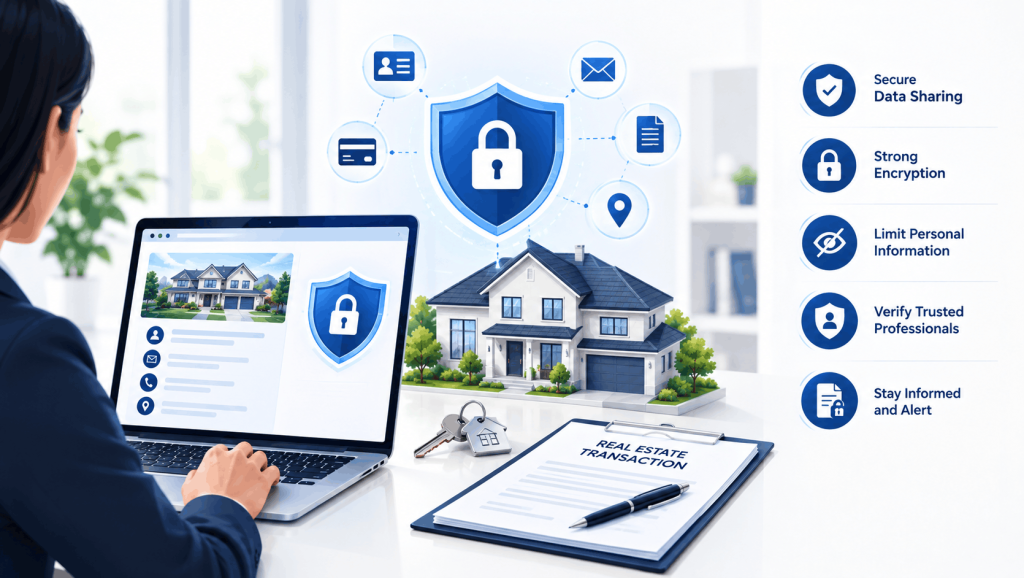
Share documents through encrypted or access-controlled portals. Ask your agent whether they use a secure transaction platform. If you must send a file by email, confirm the recipient’s address by phone first.
Be selective about open house sign-in. Many sellers use a sign-in sheet that collects only a name and general contact information, without requesting a Social Security number or income details. Dispose of sign-in sheets securely.
Review your agent’s data practices. Ask how they store client files, who has access, and how long records are kept.
Practical Steps for Home Buyers
Buyers face the highest concentration of sensitive requests, so a few habits matter a great deal.
Verify wire instructions by phone before sending any money. Call the title company using a phone number you find independently, such as on their official website or a printed closing document, not a number provided in the same email. Never rely on wire instructions received by email alone.
Provide your Social Security number only when it is required. Lenders and title companies have legitimate uses for it, but agents and inspectors typically do not. Ask why any party needs the number before sharing it.
Use strong, unique passwords and two-factor authentication. Your email account is often the gateway to your transaction. Protect it accordingly.
Confirm the identity of anyone who contacts you. If a person calls claiming to be your lender or closer, hang up and call back using a verified number.
Keep copies of everything. Maintain a secure record of documents you have sent and received, along with dates and recipients.
A Simple Verification Checklist
Before sending funds or sensitive documents, run through these questions:
- Did the request come through a channel I initiated or verified?
- Have I confirmed the wire details by phone using an independently sourced number?
- Does the requested information match what this party actually needs?
- Is there an unusual sense of urgency?
- Is the sender’s email address an exact match to the official domain?
If any answer raises concern, pause and verify before proceeding.
Comparing Secure and Unsecure Document Sharing Methods
| Method | Security Level | Best For | Key Limitation |
| Secure transaction portal | High | Full closing packages, IDs, financial records | Requires account setup |
| Encrypted email | Moderate to high | Individual documents | Depends on recipient setup |
| Standard email attachment | Low | Non-sensitive forms | Easily intercepted or forwarded |
| Text message or messaging app | Low | Scheduling and general updates | Not suitable for personal data |
| Physical delivery with tracking | High | Original signed documents | Slower, less convenient |
Most transactions benefit from a secure portal for anything containing identifiers or financial details.
Questions to Ask Your Real Estate Professional
Asking direct questions is one of the most effective privacy measures you can take. Consider asking:
- How do you store and transmit client documents?
- Do you use a secure transaction management platform?
- Who in your office or network has access to my file?
- How do you handle wire transfer instructions?
- What is your process if a suspicious message is received?
- How long do you retain client records after closing?
A professional who welcomes these questions is usually one who takes data protection seriously.
Understanding Your Legal Protections
Several laws apply to how personal information is handled in real estate. The Gramm-Leach-Bliley Act requires financial institutions, including many mortgage lenders, to explain their information-sharing practices and protect customer data. The Real Estate Settlement Procedures Act governs certain disclosures and closing procedures. State laws may add further requirements for data breach notification and consumer privacy.
These laws provide a baseline, but they do not replace your own vigilance. Ask your lender and title company for their privacy notices, and read them. They describe what information is collected, how it is used, and whether it is shared with third parties.
Why Working With Certified Professionals Helps
Data privacy depends heavily on the people handling your transaction. A poorly trained agent may share documents carelessly or fail to recognize a fraud attempt. Professionals who have completed structured training and certification are generally better equipped to recognize warning signs and follow consistent practices.
C-REPS (Certified Real Estate Pricing Specialists) is a network of licensed agents and brokers who complete specialized training, pass certification exams, meet performance requirements, maintain their membership, and follow a professional code of ethics. Certification through the National Association of BPO Professionals (NABPOP) signals a commitment to professional standards that goes beyond the minimum licensing requirements. Because C-REPS agents work as a collaborative network, clients also benefit from shared knowledge and professional accountability across the group.
Certification does not guarantee that a transaction will be free of risk. However, it does indicate that the professional has been trained and tested, and that they operate under a code of conduct that includes respect for client confidentiality.
Common Mistakes to Avoid
- Trusting an email simply because it looks official. Logos and signatures are easy to copy.
- Sending full financial records when a partial document would suffice. Redact account numbers when possible.
- Discussing wire details over unsecured channels. Confirm by phone.
- Ignoring privacy notices. They contain useful information about data sharing.
- Waiting until after a problem occurs. Set up protections at the start of the process.
What to Do If Your Information Is Compromised
If you suspect your data has been exposed, act quickly.
- Contact your bank and lender immediately, and ask them to flag your accounts.
- Place a fraud alert or credit freeze with the major credit bureaus.
- Notify your real estate agent and title company so they can verify any pending transactions.
- If funds were sent to a fraudulent account, contact your bank right away and report the incident to the FBI’s Internet Crime Complaint Center at ic3.gov.
- Document everything, including emails, phone numbers, and timestamps.
- Consider consulting an attorney if your losses are significant.
Speed matters. Wire transfers can sometimes be recalled if the fraud is reported within hours.
Frequently Asked Questions
Is it safe to send my Social Security number to my real estate agent?
Generally, no. Agents typically do not need your Social Security number. Lenders and title companies may require it for credit checks and tax reporting, so ask who needs it and why before providing it.
How can I tell if wire instructions are fraudulent?
Be cautious of any change to previously provided wire details, especially if they arrive by email. Call the title company using a phone number from an official source, not from the email, and confirm the details verbally before sending money.
Can someone find out I’m selling my home?
Your listing is public, so the sale itself is visible. However, you can limit personal details by avoiding social media posts about your moving plans and by keeping sensitive documents out of sight during showings.
Do open house sign-in sheets put my privacy at risk?
They can. Sign-in sheets that request excessive information may be used for marketing or sold to third parties. Look for sheets that collect only essential contact details, and ask the listing agent how the information will be used.
What should I do if I think I sent money to a scammer?
Contact your bank immediately and request a wire recall. Report the incident to the FBI’s Internet Crime Complaint Center at ic3.gov and to your local law enforcement. Acting within hours improves the chances of recovery.
Are digital transaction platforms secure?
Reputable platforms use encryption, access controls, and audit trails. Still, security depends on how the platform is configured and how users manage their logins. Choose platforms with clear security policies and enable two-factor authentication.
Do I need an attorney to protect my data during a sale?
An attorney is not required for routine privacy protection, but one can be valuable if you encounter a breach, a disputed transaction, or unclear contractual obligations. Many states require attorney involvement in closings, which provides an additional layer of review.
How long do real estate professionals keep my records?
Retention periods vary by state, licensing requirements, and the type of document. Ask your agent, lender, and title company about their retention policies and how they dispose of records when they are no longer needed.