
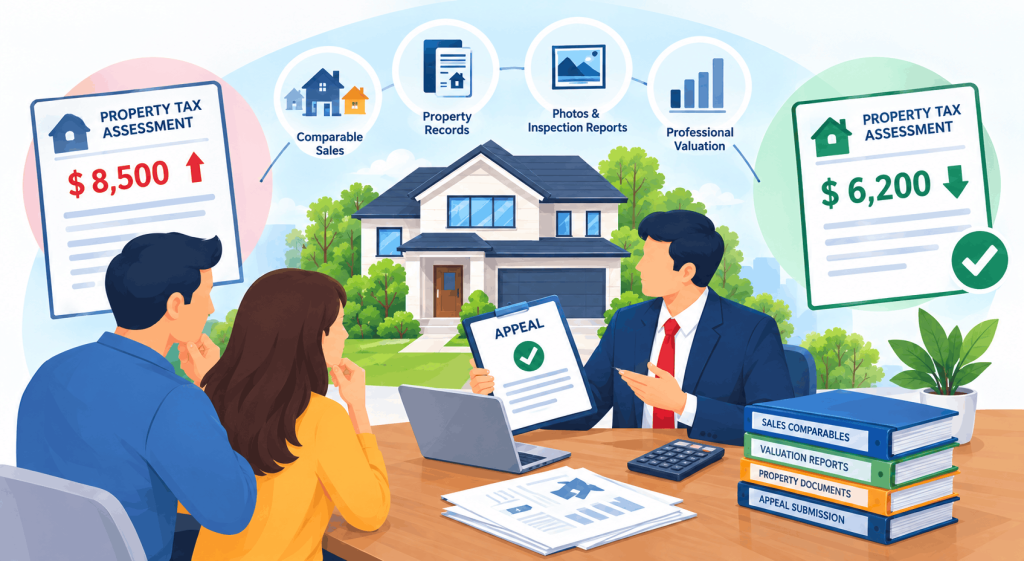
Most homeowners receive a property tax assessment notice once a year and glance at the number without thinking much about it. Yet that figure drives a significant share of the annual housing bill, and it often differs from what the home would realistically sell for. When the assessed value is too high, the owner pays more tax than the law requires, sometimes for years. The good news is that every jurisdiction that levies a property tax provides some process for challenging an assessment, and a well-supported appeal can produce a meaningful reduction.
This guide explains how property tax assessment appeals work, what makes valuation evidence persuasive, how to build a case step by step, and how to present it at a hearing. It also covers the common mistakes that cause appeals to fail and the situations where professional help is worth the cost.
What a Property Tax Assessment Appeal Is
A property tax assessment appeal is a formal request asking a local assessor, review board, or tax tribunal to correct the assessed value placed on a property. The assessment is the value the government uses to calculate tax, usually multiplied by a tax rate or millage rate. Because the tax rate is set separately, a lower assessment reduces the bill directly.
Appeals are based on the idea that assessments should reflect market value as of a specific date, which is often January 1 or another date set by the jurisdiction. Assessors use mass appraisal methods that estimate values for thousands of properties at once. These methods are efficient, but they can miss details that matter for an individual home, such as a failing foundation, an outdated kitchen, a location next to a busy road, or a sale that occurred at a price well below the assessed figure. An appeal gives the owner an opportunity to present those details and the evidence supporting them.
Assessed Value Versus Market Value
Understanding the difference between assessed value and market value is the foundation of any appeal. Market value is the price a willing buyer would pay a willing seller in an open market, with reasonable knowledge of the property and neither party under undue pressure. Assessed value is the figure the assessor assigns for tax purposes. In many places, assessed value is a fixed percentage of market value, and some states use the phrase “taxable value” or “equalized value” instead.
The gap between the two is where most appeals begin. If an assessor values a home at $420,000 but comparable homes on the same street have recently sold for $360,000, the owner has a reasonable basis to question the figure. Assessors are not required to be perfect, but they are expected to be reasonably accurate, and the owner’s job is to show where the assessment departs from the evidence.
Common Grounds for an Appeal
Successful appeals usually rest on one or more recognized grounds. Knowing which ones apply to your property helps you focus the evidence.
The first ground is overvaluation, meaning the assessed value exceeds market value. This is the most common argument, and it is typically supported by recent comparable sales, an independent appraisal, or a market analysis.
The second is factual error. Assessors sometimes record the wrong square footage, count a bedroom that does not exist, list a finished basement that is actually unfinished, or assign a property to the wrong lot. Errors like these can be corrected quickly if documented.
The third is unequal treatment, sometimes called non-uniformity. This argument shows that similar properties in the same area are assessed at a lower ratio of value than yours. Even if your assessment is close to market value, you may be paying a disproportionate share if neighbors are assessed much lower relative to what they would sell for.
The fourth is condition or external factors. Damage from fire or flood, deferred maintenance, functional obsolescence, or negative influences such as a nearby landfill can justify a lower value. These arguments require careful documentation, often including photographs, repair estimates, and inspection reports.
Know Your Deadlines Before You Begin
Appeal deadlines are strict, and missing one usually means waiting another full year. The window often opens when the assessment notice is mailed and closes within a short period, sometimes as little as 30 days, though some jurisdictions allow 45 to 60 days or more. Some states also set separate deadlines for informal review, formal appeal to a local board, and further appeal to a state tribunal or court.
Read your notice carefully. It should state the assessed value, the date, the procedure for appealing, and the deadline. If you cannot find this information, contact the assessor’s office directly and ask for written confirmation of the deadline and the required forms. Mark the date on your calendar as soon as you receive the notice, and aim to file several days early in case of mailing or submission problems.
The Evidence That Makes an Appeal Persuasive
Assessment boards decide appeals based on evidence, not on how strongly an owner feels that the number is too high. The most persuasive evidence is specific, recent, and comparable to the subject property.
Comparable sales are the strongest type of evidence in most cases. Look for three to five recent sales of similar homes within the same neighborhood or a close area. Similar means comparable in size, age, style, condition, lot size, and location. Sales should ideally have occurred within the period the assessor used for valuation, and they should be arm’s-length transactions, meaning sales between unrelated parties without unusual financing or forced circumstances. Foreclosures, estate sales, and transfers between family members may be excluded or adjusted, so note any unusual features when you present them.
An independent appraisal can carry considerable weight, especially when prepared by a licensed or certified appraiser who follows recognized professional standards. A written report should describe the property, the valuation date, the methods used, the comparable sales, the adjustments made for differences, and the final opinion of value. Appraisals cost money, but they can be worth it when the potential tax savings are substantial or when the assessor has relied on a flawed analysis.
A market analysis from a qualified real estate professional offers another useful perspective. A comparative market analysis or broker price opinion reflects recent sales, active listings, and local demand. Boards may give it less weight than a formal appraisal, depending on local practice, but it can still help you understand the market and frame your argument. Certified pricing professionals, such as those trained through the National Association of BPO Professionals (NABPOP) certification program, can provide a disciplined, market-based analysis grounded in local knowledge. It is important to be clear that these professionals are real estate agents and brokers rather than appraisers. Their analysis is most useful as supporting evidence or as a guide to the market, and some boards will accept it while others will require a licensed appraiser’s report.
Photographs, inspection reports, repair invoices, and documentation of errors in the assessor’s property record also strengthen your case. Date-stamped photos showing damage or deterioration are especially helpful when condition is part of the argument.
A Step-by-Step Approach to Building Your Case
Start by reviewing your assessment record. Most assessors make property records available online or by request. Check the square footage, lot size, number of rooms, bathrooms, year built, basement and garage details, and any listed improvements. Correct factual errors first, because they are often the easiest to fix and can reduce the value without a lengthy argument.
Next, research comparable sales. Use public records, multiple listing service data through a licensed professional, or the county recorder’s sales database. Build a simple spreadsheet listing each comparable sale, its date, sale price, size, age, condition, lot size, and any relevant differences. Be honest about differences that favor the assessor, because an evidence package that ignores them will lose credibility.
Then decide what your evidence shows. If comparable sales support a value well below your assessment, you have a strong case. If the evidence is mixed, consider whether a formal appraisal would clarify the picture. If your assessment is close to market value but neighbors are assessed much lower, focus on the equity argument.
Prepare a concise written statement that explains your position in plain language. State the assessed value, the value you believe is correct, the evidence supporting it, and the specific reasons the assessment is inaccurate. Organize exhibits in a logical order and label them so the board can follow your argument.
Finally, file the appeal on time and keep copies of every document. Many jurisdictions require the appeal form to be signed and submitted in a particular way, and some require a filing fee. Confirm the submission method and retain proof of filing.
Presenting Your Case at a Hearing
Many appeals are resolved through paperwork alone, but some move to a hearing. Preparation makes a significant difference.
Keep your presentation short and factual. Boards hear many appeals in a single session and value clarity. Begin with the assessed value you are challenging, the value you are requesting, and the main reason. Then walk through your strongest evidence, starting with the comparable sales or appraisal.
Expect questions and prepare answers. Board members may ask why a particular comparable is similar, why you chose a specific date, or how you adjusted for differences in size or condition. Answer directly. If you do not know something, say so and offer to provide the information in writing.
Be respectful even if you disagree with the assessor. Many assessors are experienced professionals working within constraints, and a cooperative tone often leads to a more productive discussion. If the assessor offers a reasonable adjustment during an informal review, consider accepting it when it is supported by the evidence.
Comparing Your Appeal Options
Owners typically choose among several paths. An informal review with the assessor’s office is the simplest and least expensive. Many errors and some valuation disputes can be resolved through a conversation and a few documents. This approach works best when the problem is a factual error or when the assessment is clearly inconsistent with recent sales.
A formal appeal to a local board of review or equalization is the next step. It requires a written filing and usually a hearing. This option suits cases where informal review fails and the evidence is strong enough to justify a formal presentation.
A further appeal to a state tax tribunal, administrative court, or circuit court is available in many places when the board’s decision is unsatisfactory. These proceedings are more complex, often require legal representation, and carry higher costs, but they can be appropriate for high-value properties or significant legal questions.
Most owners should start with the least formal option that can reasonably achieve their goal and escalate only if needed.
Common Mistakes That Undermine Appeals
Several errors appear repeatedly in unsuccessful appeals. The most common is relying on general statements, such as “my house is worth less than this” or “the market has dropped,” without specific evidence. Boards need concrete data.
Another frequent mistake is choosing comparables that are not truly similar. A home with four bedrooms and an updated kitchen is not a good comparison for a three-bedroom home with an original kitchen, unless adjustments are clearly explained and justified.
Some owners also miss the valuation date. Evidence from years ago or from after the assessment date may not be relevant unless it shows a trend that affects the valuation as of the correct date.
Finally, many appeals fail because the deadline is missed. Owners who wait for a convenient moment often discover that the window has closed. Early preparation is one of the most effective strategies available.
Practical Examples
Consider a homeowner whose assessment rose sharply during a period of rapid local price growth. The assessor valued the home at $380,000. The owner gathered sales records for four nearby homes that sold between $330,000 and $355,000 over the prior six months. Two of the comparables were similar in size and condition, and the others required modest adjustments for garage size. The owner filed a formal appeal with a comparable sales analysis and photographs of an outdated roof. The board reduced the assessment to $352,000, lowering the annual tax by a meaningful amount.
In a second example, a property owner discovered that the assessor’s record listed a finished basement that had never been completed. The basement was unfinished storage space with no heat and no bathroom. The owner provided the original plans, a current photograph, and a letter from a contractor confirming the condition. The assessor corrected the record during informal review, and the assessment dropped substantially without a formal hearing.
A third example involves an investor with several rental properties. Two properties in the same subdivision were assessed at a much higher ratio of market value than the investor’s other holdings. The investor documented the assessment ratios for comparable properties in the area and filed a non-uniformity appeal. The board adjusted the assessments to bring them closer to the common ratio, reducing the tax burden across the portfolio.
Actionable Advice for Homeowners
Check your assessment notice as soon as it arrives and note the appeal deadline immediately. Do not assume the assessor will correct an error on their own.
Review your property record for factual accuracy. Correcting errors is often the quickest path to a lower assessment.
Gather at least three recent comparable sales and compare them carefully to your home. Be honest about differences, and explain any adjustments you make.
Consider a formal appraisal if the potential tax savings are significant or if the evidence is contested. Choose a licensed or certified appraiser with experience in property tax work.
If you want a market-based perspective on your home’s value, a certified pricing professional can prepare a comparative analysis. Ask whether the local board accepts this type of evidence before you rely on it.
Keep every document, note the names of people you speak with, and record the dates of all communications. Good records make the process smoother if the case moves forward.
When to Consider Professional Help
Many homeowners handle informal reviews and simple appeals on their own. Professional help becomes more valuable when the property is high-value or unusual, when the assessment difference is large, when the local process is complex, or when a further appeal to a tribunal or court is likely.
A property tax attorney or consultant can review the assessment, identify legal arguments, and represent you at hearings. Some consultants work on contingency, taking a percentage of the tax savings. Read any fee agreement carefully and understand what is included.
An independent appraiser can provide a report that the board will recognize as authoritative. For many contested cases, this is the single most useful investment.
Frequently Asked Questions
Can I appeal my property tax assessment if I do not think it is wrong?
Yes, but you should have evidence before filing. Boards expect appeals to be supported by specific data showing that the assessment exceeds market value, contains errors, or is inconsistent with similar properties. Without evidence, an appeal is unlikely to succeed and may cost time and fees. Reviewing comparable sales is a good first step to decide whether an appeal is justified.
How long does a property tax appeal take?
The timeline varies by jurisdiction. An informal review may be resolved in a few weeks, while a formal board hearing can take several months from filing to decision. Further appeals to a tribunal or court may take considerably longer. Ask the assessor’s office for the typical schedule in your area.
Do I need a lawyer to appeal my property taxes?
Most homeowners can file an appeal and present their case without a lawyer, especially for residential properties and straightforward issues. Legal help becomes more valuable for complex cases, high-value properties, or appeals beyond the local board. Some jurisdictions also have free or low-cost assistance programs for homeowners.
Will a lower assessment always mean a lower tax bill?
A lower assessment usually reduces the tax bill, but the effect depends on the tax rate, any exemptions or caps, and how the jurisdiction calculates tax. In some places, a reduction in assessed value may be offset by a change in the tax rate, so it is worth asking how the appeal will affect your actual bill.
Can my assessment go up if I file an appeal?
In some jurisdictions, the board has authority to review the property as a whole and could increase the assessment if it finds the original value was too low. This is uncommon but possible. Ask the assessor’s office whether this risk exists in your area before filing.
What evidence carries the most weight with an assessment board?
Recent, arm’s-length comparable sales that closely match the subject property usually carry the most weight. A licensed or certified appraisal prepared under recognized standards is also highly persuasive. Documented factual errors and clear evidence of condition problems can be decisive when they are supported by photographs and third-party records.
Can I appeal every year?
Most jurisdictions allow annual appeals, but the rules vary. Some limit appeals to specific periods, such as reassessment years, while others allow appeals whenever the assessment is significantly inaccurate. Check your local rules before assuming you can file in a given year.
Is a real estate agent’s price opinion accepted in an appeal?
It depends on the jurisdiction and the board. Some boards accept market analyses as supporting evidence, while others require a formal appraisal from a licensed or certified appraiser. A certified pricing professional’s analysis can still be valuable for understanding the market and for building the factual basis of your case, even when it is not the primary evidence.
What happens if I win my appeal?
If the board reduces your assessment, the change is usually applied to the current tax year and may affect future years until the next reassessment. You may receive a revised tax bill or a credit for taxes already paid. Confirm the outcome in writing and keep a copy of the decision for your records.