
How Interest Rates Affect Property Values: Expert Analysis
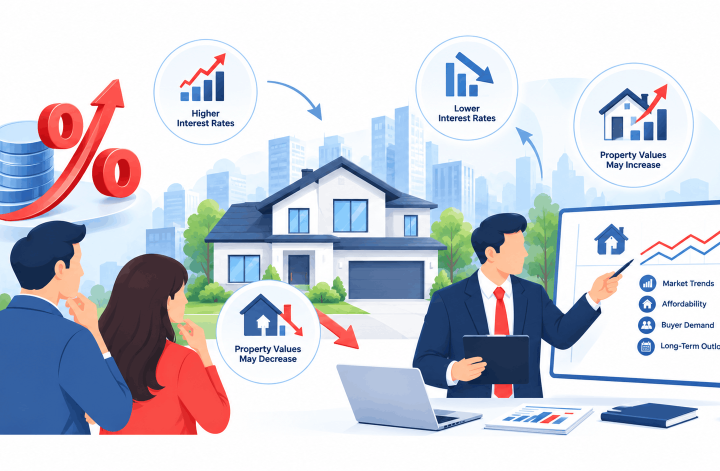
Few forces shape the housing market as directly as interest rates. When mortgage rates move, buyers’ budgets change, sellers’ pricing decisions change, and the number of homes that actually sell changes with them. Yet many people still ask a simple question: if rates go up, do home values fall?
The honest answer is that interest rates influence property values through several channels at once, and those channels do not always move in the same direction. This analysis explains how rates affect what buyers can pay, why the link between rates and prices is not one-to-one, what current forecasts suggest for 2026, and how professionals who specialize in accurate pricing account for rate changes when they value a home.
How Interest Rates Reach Property Values
Most homes are bought with a mortgage, so the interest rate on that loan becomes a central part of the price a buyer can afford. A property’s market value is not set by rates alone, but rates shape the pool of people who can pay a given price and the terms under which they are willing to pay it.
Three channels do most of the work.
The Affordability Channel
The most direct effect is on monthly payments. Consider a buyer borrowing $400,000 on a 30-year fixed mortgage. At 6%, the principal and interest payment is about $2,398 per month. At 7%, it rises to about $2,661, roughly $263 more each month, or about 11% higher, for the same loan amount.
Put differently, if a buyer can comfortably afford $2,398 per month, a 7% rate reduces the loan they can support to about $360,000. That is roughly 10% less purchasing power for the same budget. Every percentage point increase in mortgage rates reduces what a given income can buy by a similar order of magnitude.
When many buyers lose purchasing power at once, demand softens. Weaker demand usually shows up first in fewer offers, longer time on the market, and more negotiation, and only later in lower prices.
The Buyer Demand Channel
Rates also affect how many people decide to enter the market at all. Higher rates generally reduce buyer demand, and some buyers choose to wait for better conditions. Tembo, a mortgage advisory firm, has argued that if rates stay at or near current levels, more buyers may hold off purchasing, and that an overpriced home will struggle to sell in that environment.
This is one reason rate changes can matter more than their size suggests. A fall in rates can bring buyers back quickly, and the surge in demand can push prices up if supply does not keep pace.
The Lock-In Channel
The third channel is less obvious. Many homeowners locked in low mortgage rates during the years when borrowing was cheap. Those owners have a strong financial reason to stay put, which keeps the supply of existing homes for sale low. Morgan Stanley strategists have pointed to this lock-in effect as a factor that has constrained supply and supported higher prices, even when rates are elevated.
This creates a counterintuitive result. High rates reduce buyer demand, but they can also reduce supply, so prices may hold up better than a simple affordability model would predict. The net effect depends on which force is stronger in a given market.
Why the Relationship Is Not Simple
Rates and prices move together in many periods, but the relationship is not a fixed formula. Economic conditions can change how rates affect values.
During periods of strong economic growth and rising incomes, buyers may be willing to pay more even when rates are higher, which can keep prices firm. During periods of economic weakness, higher rates can reduce both demand and prices more sharply.
The housing market’s history illustrates this. The period before the 2008 financial crisis involved rising prices and widespread borrowing, followed by a sharp decline in values and sharp changes in lending conditions. Today’s market differs in important ways, including the prevalence of fixed-rate loans and the level of homeowner equity, so historical episodes should be read as context rather than a forecast.
Rates also reach valuations through the financing environment. Investors who buy property with borrowed money feel rate changes directly in their carrying costs, which affects how much they are willing to pay for rental and commercial properties. Residential buyers, meanwhile, respond to monthly payments and their personal budgets.
What Current Forecasts Show
Forecasters are not in full agreement about where rates and prices are headed, which is itself a useful signal about uncertainty.
Freddie Mac’s Primary Mortgage Market Survey put the average 30-year fixed rate in a range of roughly 6.11% to 6.25% in early 2026. Forecasts for the end of 2026 vary. The Mortgage Bankers Association projects rates near 6.4%, Realtor.com projects about 6.3%, and Fannie Mae has been more optimistic, expecting around 5.9%. Morgan Stanley strategists have suggested rates could decline to around 5.75%, particularly in the first half of the year.
For prices, the picture is similarly mixed. Zillow forecasts that home values will rise just 1.2% this year, while Cotality, a real estate analytics firm, has reported that annual home price appreciation slowed from 3.4% in January to 1.1% by October, a slowdown it attributed to elevated mortgage rates and persistent affordability challenges. Cotality’s own forecast projects future annual growth of 4.3% for October 2026, and it warns that a notable drop in rates combined with low supply could reaccelerate price gains.
| Indicator | Forecast Range Cited | Key Takeaway |
| 30-year rate, end of 2026 | About 5.75% to 6.4% | Forecasters expect modest movement, with no consensus on direction |
| Home price change | About 1% to 4% | Growth is expected to be slower than in recent peak years |
| Inventory | Gradual improvement | Supply is expected to rise slowly, supporting more balanced conditions |
The lesson from these forecasts is that rates and prices are linked through the supply side as well as the demand side. A rate decline alone does not guarantee falling or rising prices. The combination of rates, supply, and local demand determines the outcome.
Rate Changes Do Not Hit Every Property Equally
One of the most important insights for anyone analyzing property values is that interest rates affect different segments of the market in different ways.
Entry-Level Homes
Starter homes and lower-priced properties are often most sensitive to rate changes. Buyers in this segment tend to rely heavily on mortgage financing, and a small change in rate can change qualification for a loan. When rates rise, the number of qualified buyers can drop quickly, which can put pressure on prices in the most affordable price bands.
Higher-Priced Homes
Buyers of higher-priced homes may use more cash or have more financial flexibility, so rate changes can affect them differently. Some buyers in this segment are less sensitive to a half-point change, while others still face meaningful differences in monthly costs.
Investment Properties
Investors feel rates through financing costs, rental yields, and the spread between borrowing costs and expected returns. When rates rise, investors often demand lower purchase prices to earn their target return. When rates fall, they may be willing to pay more, which can lift values in rental-heavy neighborhoods.
Local Markets
National averages can hide enormous variation. A market with rising inventory and softer employment may see prices fall even as the national trend is flat. A market with limited new construction and strong job growth may see prices rise despite high rates. This is why a national rate forecast is a starting point, not a valuation tool.
The Valuation Side: How Professionals Account for Rates
A property’s value is ultimately what a willing buyer will pay, and that figure depends on current financing conditions. For this reason, accurate pricing requires professionals to account for rates rather than relying on past sales alone.
C-REPS professionals are licensed real estate agents and brokers who complete specialized pricing training through the National Association of BPO Professionals (NABPOP) certification program. Their work emphasizes what buyers are actually willing to pay in a specific local market today. In a higher-rate environment, that often means paying close attention to how buyers are responding to listings, how many are qualifying at current payment levels, and whether recent sales reflect the financing reality of this period rather than an earlier one.
Rates matter for valuation in several practical ways:
- Recent sales may reflect different financing conditions. A home that sold during a low-rate period may not be a reliable comparison for a home listed when rates are higher.
- Buyer pool size matters. If fewer buyers can afford a given price, the likely sale price may need to adjust.
- Time on market is a signal. Longer listing periods can indicate that a price is out of step with current buyer willingness to pay.
- Concessions tell a story. Seller credits, rate buydowns, and closing cost help can reveal how much buyers need financial relief to complete a purchase.
A useful principle is to ask whether a comparable sale reflects the same market conditions you face today. If the answer is no, the sale still matters, but it needs adjustment.
Practical Examples
Example One: A Seller in a Higher-Rate Market
Suppose a homeowner in a mid-sized metro area believes their home is worth what a similar home sold for two years earlier, when mortgage rates were noticeably lower. Their neighbor’s sale may still be useful, but the current buyer pool is smaller at today’s rates. A pricing professional would compare recent sales from the past several months, check how many similar homes are currently listed, and look at how quickly they are selling. The likely conclusion is that the home should be priced to current buyer capacity rather than the peak of the earlier market.
Example Two: A Buyer Deciding Whether to Wait
A buyer considering a $400,000 home has two possibilities. At a 6% rate, their payment is about $2,398 per month. If they wait and rates fall to 5%, that payment drops to about $2,147, a difference of roughly $250 per month. But if prices rise while they wait, or if rates rise instead, the advantage disappears. A buyer who can afford the monthly payment today and plans to stay in the home for several years may find that waiting has a real cost. A buyer who is stretched to afford the payment may benefit from a longer wait, but only if they have a clear plan for their finances in the meantime.
These examples show why there is no universal answer. The right decision depends on payment capacity, time horizon, local supply, and the price being negotiated.
Actionable Advice for Buyers, Sellers, and Investors
For buyers:
- Calculate your monthly payment at several rate levels, including one or two percentage points higher than today’s rate, before setting a budget.
- Get pre-approved with more than one lender, since rate and fee differences can meaningfully change your payment.
- Look at homes in the context of local sales and time on market, not only the list price.
- Consider whether a rate buydown, seller credit, or lender credit could offset the payment more effectively than waiting.
For sellers:
- Price based on current buyer capacity, not on a peak market you remember.
- Ask your agent to explain how recent comparable sales reflect today’s financing conditions.
- Be prepared for buyers to ask for concessions when rates are high, and decide in advance what you are willing to offer.
- If the market is slow, act early on pricing adjustments rather than waiting for a rate change to rescue the listing.
For investors:
- Stress-test your returns at higher financing costs, not only at current rates.
- Compare the expected rental yield with your borrowing cost, and avoid assuming that falling rates will automatically lift values.
- Consider how refinancing options and fixed versus variable loan structures affect your risk.
- Recognize that lock-in effects can keep supply tight in some areas, which may support values even when demand softens.
The Bottom Line
Interest rates influence property values through affordability, buyer demand, and the supply of homes for sale, and their effects vary by price range, property type, and local market. Forecasts for 2026 do not agree on the direction of rates or prices, which is a reminder that the relationship depends on many factors at once.
The most useful approach is to focus on what rates mean for your specific situation: your monthly payment, your time horizon, and the comparable sales in your area. For buyers, that means budgeting realistically. For sellers, it means pricing to current buyer capacity. For investors, it means stress-testing returns against higher financing costs. Accurate pricing grounded in local data remains the most reliable way to navigate a market where rates keep shifting.
Frequently Asked Questions
Do higher interest rates always lower home prices?
No. Higher rates usually reduce buyer demand and purchasing power, which can soften prices, but they can also reduce supply because homeowners with low rates are less likely to sell. The net effect depends on local supply and demand, employment, and economic conditions.
How much does a 1% rate increase affect a mortgage payment?
It depends on the loan size and the starting rate. On a $400,000 30-year loan, moving from 6% to 7% increases the monthly principal and interest payment by about $263, or roughly 11%.
Will mortgage rates go down in 2026?
Forecasts differ. Some expect rates to decline modestly by the end of 2026, while others expect them to stay near current levels. No forecast can guarantee the direction, so buyers and sellers should plan for a range of outcomes.
Why are home prices not falling more when rates are high?
Several factors can keep prices from falling sharply. Many homeowners have low locked-in rates and are reluctant to sell, which limits supply. Demand for housing also remains strong in some areas, and high construction costs can limit new supply.
Does a rate drop always make homes more expensive?
Not always, but it can. Lower rates can bring more buyers into the market quickly. If supply is limited, that extra demand can push prices up. If supply is growing, the effect may be smaller.
Should I wait for lower rates before buying a home?
It depends on your finances and your plans. Waiting can make sense if you need more time to build savings or if rates fall enough to offset potential price increases. Buyers who can afford the current payment and plan to stay for several years often find that the cost of waiting is higher than expected.
How do professionals factor interest rates into home pricing?
Pricing professionals look at recent comparable sales, time on market, buyer activity, and concessions. They consider whether past sales reflect current financing conditions and adjust their analysis when they do not.
Can rate buydowns or seller credits offset high rates?
They can reduce the effective cost of a loan in some situations, but the details matter. Buydowns, credits, and fee structures vary, so buyers should compare the total cost of different options rather than focusing only on the headline rate.