
How C-REPS Professionals Give Back to Their Communities

Real estate transactions touch families, neighborhoods, and local economies. A home sale can shape a household’s finances for decades, and a single pricing decision can affect an entire street. For that reason, the people who guide these transactions carry a responsibility that extends well beyond their commissions. C-REPS professionals take that responsibility seriously. They pair certified pricing expertise with a commitment to the communities where they live and work.
This article explains what giving back looks like in the real estate profession, how the C-REPS standard shapes community involvement, and which specific contributions make the biggest difference. It also offers practical guidance for anyone who wants to evaluate whether an agent’s community commitment is genuine.
What Giving Back Means in Real Estate
Giving back is a broad idea, and in real estate it can take many forms. Some agents donate money or time to local charities. Others focus on education, helping residents understand how the housing market works. Still others channel their professional skills into projects that benefit the people around them.
The strongest examples of community contribution share a common feature: they draw on the professional’s core expertise. A pricing specialist can help neighbors understand what their homes are worth. A market analyst can share trends that help first-time buyers plan. A licensed agent who knows local zoning, inventory, and buyer behavior can offer insight that few other people in a neighborhood possess.
Why Community Involvement Matters for Agents
Real estate professionals depend on local trust. Buyers and sellers want to work with someone who understands their town, respects their neighbors, and will still be around after the closing table. Community involvement builds that trust over time. It shows that an agent’s interest extends past a single transaction and into the long-term health of the place they serve.
Community involvement also creates a useful feedback loop. Agents who spend time listening to residents learn which concerns come up repeatedly, whether that is rising property taxes, a shortage of starter homes, or confusion about disclosure rules. That knowledge improves their work with clients.
The C-REPS Standard: Professional Ethics as a Foundation for Service
C-REPS (Certified Real Estate Pricing Specialists) is a network of certified, professional real estate agents and brokers who specialize in accurate property pricing and market expertise. C-REPS professionals are trained, tested, and certified through the National Association of BPO Professionals (NABPOP) certification program.
The designation requires agents to complete specialized training, pass certification exams, meet performance requirements, maintain membership, and follow a professional code of ethics. Each of these elements supports community contribution in its own way.
Certification and Accountability
Certification sets a baseline of competence. When an agent has completed structured training and passed examinations, clients and neighbors have a reasonable basis for confidence in that agent’s knowledge. Performance requirements and ongoing membership add accountability, because the professional must keep meeting standards over time rather than relying on a credential earned years ago.
For community members, this matters in a practical way. Someone deciding whether to trust a local agent with a family’s most important financial decision benefits from knowing that the agent operates under recognized standards and a published code of ethics.
The Collaborative Network
C-REPS professionals are not solo practitioners. They work within a collaborative professional network, which means knowledge, resources, and standards are shared across members. This structure allows agents to learn from peers, refine their pricing methods, and bring a broader perspective to local questions. It also means community-minded practices can spread across the network rather than remaining isolated to one office.
Five Ways C-REPS Professionals Contribute
Community contribution looks different from one agent to the next. The following areas represent common and meaningful ways C-REPS professionals serve their neighborhoods.
Local Market Education
Many residents feel uncertain about the housing market. They hear conflicting reports about prices, interest rates, and inventory, and they may not know which information to trust. C-REPS professionals can help by offering clear, accurate explanations of local conditions. This might take the form of neighborhood workshops, informational sessions at community centers, or plain-language guides shared through local channels.
The goal of this education is to help people make informed decisions, whether or not they ever hire the presenting agent. An informed community is a healthier community.
Honest Pricing as a Community Service
Accurate pricing is one of the most underrated forms of community contribution. When a home is priced too high, it can sit on the market, become stale, and eventually sell for less than it could have with a realistic starting point. When a home is priced too low, sellers lose money they were entitled to keep. Both outcomes affect the broader neighborhood, because comparable sales feed into the valuations of nearby properties.
C-REPS professionals approach pricing with a rigorous method that combines formal training with real-market knowledge. They focus on what buyers are actually willing to pay today in the local market. This disciplined approach protects individual sellers and helps keep neighborhood price data reliable for everyone.
Volunteering and Neighborhood Support
Many C-REPS professionals volunteer their time with local organizations. Common areas of involvement include housing nonprofits, neighborhood associations, food banks, youth programs, and school support groups. Volunteering allows agents to contribute skills, time, and energy in ways that align with their values.
Agents who volunteer consistently often develop deeper relationships in the community. These relationships are not a sales tactic when they grow from genuine participation. They are a natural result of showing up for the people and causes that matter locally.
[Insert specific local volunteer examples here, such as the organizations your agents support and the roles they play.]
Supporting First-Time Buyers and Housing Access
Buying a first home can feel overwhelming, especially for people unfamiliar with mortgage terminology, inspection processes, or the steps of a purchase agreement. C-REPS professionals can support first-time buyers by explaining each stage clearly, setting realistic expectations about budgets, and helping them avoid common mistakes.
This kind of guidance has a community dimension. When more residents become confident homeowners, neighborhoods gain stability and investment. Agents who take time to educate new buyers help build the kind of long-term local ownership that strengthens a town.
Mentoring and Professional Development
Strong communities also depend on strong professionals. Experienced C-REPS agents can mentor newer agents, sharing knowledge about pricing methods, client communication, and ethical practice. This mentorship raises the overall quality of service available to the public. It also reflects the collaborative spirit of the network, where professional growth benefits everyone.
Corporate Responsibility and Brand Values
Corporate responsibility is a term often used in business, and it applies to real estate firms and independent agents alike. It refers to the idea that a business has obligations to its customers, employees, and community, not just to its shareholders or owners. In practice, corporate responsibility shows up in how a firm treats clients, how it handles information, and how it contributes to the places it serves.
The table below compares a traditional, transaction-focused approach with the approach that C-REPS professionals aim to practice.
| Area | Transaction-Focused Approach | C-REPS Approach |
| Pricing | Set price to win the listing | Price based on trained analysis of current local demand |
| Credentials | Licensed only | Certified through structured training, examinations, and a code of ethics |
| Client relationship | Focused on closing | Focused on long-term guidance and accurate information |
| Community role | Occasional or unspecified | Ongoing education, volunteering, and neighborhood support |
| Professional standards | Minimum legal requirements | Higher ethical and performance expectations |
| Network | Individual practice | Collaborative professional network |
This comparison is not meant to criticize every agent outside the C-REPS network. Many professionals serve their communities with integrity. The difference lies in the structure of the standard itself. C-REPS professionals agree to meet defined expectations, and those expectations explicitly include ethical conduct and ongoing professional commitment.
Practical Examples of Community Contribution
Abstract principles become clearer through specific cases. Consider the following scenarios that illustrate how community contribution can work in practice.
Example one: A neighborhood pricing workshop. An agent hosts a free evening session at a local library to explain how comparable sales are selected and how market conditions affect value. Attendees leave with a clearer understanding of how appraisals and listing prices relate to actual buyer behavior. Several homeowners later reach out with questions, and a few choose to work with the agent, but the session’s primary goal was education.
Example two: Guiding a first-time buyer through a difficult market. A young couple wants to buy their first home but feels discouraged by competitive offers. A C-REPS professional walks them through realistic budgeting, explains how pricing works in their target neighborhood, and helps them avoid overpaying in a bidding situation. The couple secures a home they can afford, and the agent gains a long-term client who later refers friends.
Example three: Helping a senior homeowner plan a downsizing decision. A longtime resident wants to sell a family home and move to a smaller property nearby. The agent provides an accurate valuation, explains the timing options, and connects the family with trusted local resources for moving and estate planning. The resident feels respected rather than pressured.
Example four: Supporting a local housing nonprofit. An agent volunteers to share pricing and market knowledge with a nonprofit that helps families access affordable housing. The agent’s expertise helps the organization set realistic program parameters and better understand local conditions.
[Replace or supplement these examples with verified, real stories from your C-REPS network members, with permission.]
How to Evaluate an Agent’s Community Commitment
If you are looking for a real estate professional, community involvement can be a useful indicator of values. It is not the only factor, and you should always evaluate an agent’s credentials, experience, and fit with your needs. However, the following questions can help you assess whether an agent’s commitment to the community is genuine.
- Ask whether the agent holds a recognized professional certification and what that certification requires.
- Ask how the agent determines a home’s price and what data sources they rely on.
- Ask which local organizations the agent has supported and what role they played.
- Ask whether the agent offers educational resources or community sessions.
- Ask how the agent handles situations where the most profitable option for them differs from the best option for you.
- Look for consistency. Long-term involvement tends to be more meaningful than a single event.
A good agent will answer these questions openly and without pressure. If an agent deflects, becomes vague, or emphasizes urgency rather than information, that response is worth noting.
Conclusion
Giving back is not a separate activity for C-REPS professionals. It flows naturally from the standards they follow, the expertise they develop, and the communities they serve. Through certification, honest pricing, local education, volunteering, and mentorship, these professionals contribute to neighborhoods that are better informed and more stable.
If you are considering a move, a sale, or a purchase, consider looking for an agent whose values match your own. Ask questions, look for consistency, and choose someone who treats your decision with the seriousness it deserves. Communities grow stronger when the people guiding their most important transactions care about the long-term health of the place they call home.
Frequently Asked Questions
What does C-REPS stand for?
C-REPS stands for Certified Real Estate Pricing Specialists. It is a network of certified, professional real estate agents and brokers who specialize in accurate property pricing and market expertise.
How do C-REPS professionals get certified?
C-REPS professionals are trained, tested, and certified through the National Association of BPO Professionals (NABPOP) certification program. The designation requires specialized training, certification exams, performance requirements, ongoing membership, and adherence to a professional code of ethics.
How is a C-REPS professional different from an average real estate agent?
C-REPS professionals complete structured certification and agree to a higher set of professional and ethical standards. They combine formal pricing training with real-market knowledge and work within a collaborative network rather than operating in isolation.
How do C-REPS professionals give back to their communities?
Common contributions include offering local market education, providing accurate pricing that protects sellers and neighborhood data, volunteering with local organizations, supporting first-time buyers, and mentoring newer agents. The specific activities vary by agent and region.
Why does accurate pricing count as a community contribution?
Accurate pricing protects individual sellers from losing money through overpricing or underpricing. It also keeps comparable sales data reliable, which affects valuations for nearby homes. Consistent, honest pricing supports a more stable local market.
Can I work with a C-REPS professional if I am a buyer?
Yes. C-REPS professionals serve home buyers, home sellers, homeowners, and investors. Buyers benefit from agents who understand what properties are actually worth in their target area, which can help them negotiate with confidence.
Do I need to be a homeowner to benefit from community education sessions?
No. Most community education efforts are open to residents, renters, and prospective buyers. Local libraries, community centers, and neighborhood associations are common places to find these sessions.
How can I find a C-REPS professional near me?
You can start by searching for C-REPS members in your area and reviewing their profiles, certifications, and community involvement. Asking direct questions during an initial conversation will also help you judge fit.
C-REPS Networking Events and Community Involvement: How a Professional Network Strengthens Real Estate Expertise

Buying or selling a home is one of the largest financial decisions most people make, and the professional who guides that decision matters. Many consumers quickly learn that not every real estate agent brings the same training, the same standards, or the same depth of local market knowledge. The C-REPS professional network was built to address that gap, and its networking events and community involvement are a large part of how it does so.
This article explains what the C-REPS community is, how its networking events work, why collaboration among certified professionals benefits the public, and how consumers can use this knowledge when choosing an agent.
What Is the C-REPS Professional Network?
C-REPS stands for Certified Real Estate Pricing Specialists. It is a network of certified real estate agents and brokers who focus on accurate property pricing and market expertise. Members are active licensed professionals, not appraisers, who have chosen to add specialized pricing training to their everyday work.
Members are trained, tested, and certified through the National Association of BPO Professionals (NABPOP) certification program. The designation requires agents to complete specialized training, pass certification exams, meet performance requirements, maintain their membership, and follow a professional code of ethics. Those requirements exist so that a C-REPS designation signals more than a name on a business card.
Who Are C-REPS Professionals?
C-REPS professionals share several common traits:
- They are active real estate agents or brokers.
- They commit to ongoing professional development and continuing education.
- They combine systematic pricing training with deep knowledge of their local markets.
- They work as part of a collaborative network rather than as isolated practitioners.
- They are held to higher professional and ethical standards than the average agent.
That final point matters for consumers. The industry includes many talented agents, but it also includes people who are new, part-time, or focused mainly on closing a quick transaction. A certification program with defined standards gives buyers and sellers a clearer way to evaluate who they are working with.
Why Networking Matters in Real Estate Pricing
Pricing a home well depends on more than comparing a few recent sales. Accurate pricing requires understanding what buyers are actually willing to pay today, how neighborhoods are shifting, which features are drawing offers, and how local conditions differ from one street to the next.
No single agent sees every transaction in a metro area. A collaborative network allows professionals to share perspectives, compare observations, and learn from one another’s experience. For a consumer, this means the expertise behind a single agent can be broader than that agent’s personal caseload.
This is the core idea behind C-REPS networking. The network is designed so that professionals strengthen one another’s work, and the public benefits from that shared knowledge.
Inside a C-REPS Networking Event
C-REPS networking events bring certified members together to exchange knowledge, discuss market conditions, and build the working relationships that make collaboration possible. While formats can vary by region and season, most professional networking gatherings in the C-REPS community share a few common goals.
Common Goals of Networking Gatherings
- Market discussion: Members compare what they are seeing in their local areas, including shifts in buyer demand, inventory trends, and pricing patterns.
- Training and professional development: Events often reinforce pricing methods, ethical standards, and best practices.
- Relationship building: Members get to know one another in person, which makes future referrals and collaboration more natural.
- Peer learning: Experienced professionals share approaches that have worked for them, and newer members gain practical perspective.
What Attendees Typically Gain
Professionals who participate in networking events often come away with clearer insight into how their own markets compare with others. They also build a reference network of colleagues they can consult when a transaction involves an unfamiliar property type or price range.
For consumers, the value shows up indirectly. An agent who stays connected to a professional community tends to have more current market information, more perspectives to draw on, and a stronger habit of continuing education.
Community Involvement Beyond the Event Room
Networking is not limited to scheduled gatherings. C-REPS community involvement extends into the everyday ways professionals serve their clients and their neighborhoods.
Ways Members Stay Engaged
- Participating in continuing education and certification maintenance
- Sharing market observations with fellow members
- Mentoring newer professionals who are building their pricing skills
- Supporting local buyers and sellers with accurate, data-informed guidance
- Maintaining the ethical standards the designation requires
Community involvement also reflects a broader philosophy. C-REPS professionals see themselves as market makers who know real buyers, real sellers, and real prices. That perspective encourages members to stay grounded in what actually happens in their communities rather than relying on outdated assumptions.
The Difference Teamwork Makes for Clients
One of the most distinctive features of C-REPS is its collaborative structure. When you hire one C-REPS agent, you gain access to the broader network. That means your agent can draw on colleagues’ knowledge when your property or your market presents an unusual challenge.
Consider a practical example. A homeowner in a neighborhood with few recent sales of similar homes wants to know a realistic list price. A single agent working alone may struggle to find comparable data. A C-REPS professional can consult fellow members who work in adjacent areas or who have handled similar properties, then bring that combined perspective back to the homeowner.
How Collaboration Can Help Different Clients
- Home sellers benefit from pricing informed by a wider set of market observations, reducing the risk of overpricing or leaving money on the table.
- Home buyers gain insight into whether an asking price reflects current local demand.
- Homeowners and investors can receive valuations grounded in both training and real-market knowledge.
- Anyone entering an unfamiliar area can tap into local knowledge from members who already work there.
How C-REPS Differs From a Typical Agent Search
Many people begin their agent search by looking at online reviews or asking friends. Those are useful starting points, but they do not always reveal how an agent approaches pricing or ethics. Certification adds another layer of evidence.
| Factor | Typical Agent | C-REPS Professional |
| Pricing training | Varies widely | Specialized training and testing required |
| Certification | Often a general license only | Certified through NABPOP program |
| Market approach | Often relies on individual experience | Combines training with real-market knowledge |
| Network access | Usually limited to the individual or brokerage | Access to a collaborative professional network |
| Ethical standards | Set by license requirements | Follows a professional code of ethics as a condition of membership |
| Ongoing commitment | Varies | Requires maintaining membership and performance standards |
This comparison does not mean every agent outside the network is unqualified. It means certification provides a structured way to verify commitment to professional standards.
Questions to Ask Any Agent You Are Considering
Whether or not you choose a C-REPS professional, asking the right questions helps you find a trustworthy agent. Consider asking:
- What training or certifications have you completed related to pricing?
- How do you determine what buyers are willing to pay in my specific area?
- Do you participate in any professional networks or continuing education programs?
- How do you handle situations where my property has few comparable sales?
- What ethical standards guide your work?
A strong agent will answer these questions clearly and will not pressure you to decide immediately.
Practical Steps for Consumers
If you are looking for a certified professional, these steps can help you make an informed choice:
- Verify credentials. Ask for proof of any certification you are considering, and confirm it is current.
- Compare approaches. Ask each agent how they would price your home or evaluate a purchase, and compare the reasoning, not just the number.
- Check local knowledge. Ask how long the agent has worked in your area and what they have observed recently.
- Review professional commitment. Look for signs of continuing education and active participation in professional communities.
- Trust your instincts. A professional who explains their process patiently is usually a good sign.
Frequently Asked Questions
What does C-REPS stand for?
C-REPS stands for Certified Real Estate Pricing Specialists. It is a network of certified agents and brokers who focus on accurate property pricing and market expertise.
Who certifies C-REPS professionals?
C-REPS professionals are trained, tested, and certified through the National Association of BPO Professionals (NABPOP) certification program.
Are C-REPS professionals appraisers?
No. C-REPS members are active real estate agents and brokers. Their pricing training is designed for their work as licensed agents, which is different from the role of a licensed appraiser.
What happens at a C-REPS networking event?
Networking events bring certified members together to discuss market conditions, share training insights, and build professional relationships. Formats can vary by region.
How can I benefit from the C-REPS network if I hire one agent?
When you work with one C-REPS professional, that agent can draw on the collaborative knowledge of the broader network, which can be especially useful for unusual properties or unfamiliar markets.
Do C-REPS professionals follow a code of ethics?
Yes. Certification requires agents to follow a professional code of ethics, and members are held to higher professional and ethical standards than the average agent.
How do I find a C-REPS professional near me?
Start by visiting the official C-REPS website or contacting the network directly for a listing of certified members in your area. Always confirm a member’s current certification before you commit.
Is C-REPS certification the only thing I should look for?
No. Certification is one important factor. Also consider the agent’s local experience, communication style, responsiveness, and how well they explain their pricing process.
Next Steps: Connecting With the C-REPS Community
If you value accurate pricing, professional training, and genuine client partnership, the C-REPS network is worth exploring. Whether you are preparing to sell, looking to buy, or simply want a valuation you can trust, a certified professional can help you understand your options clearly.
When you are ready, you can reach out to a certified C-REPS professional in your area to discuss your goals. There is no obligation to act immediately, and a good agent will respect your timeline.
Becoming a C-REPS Certified Professional: A Step-by-Step Guide
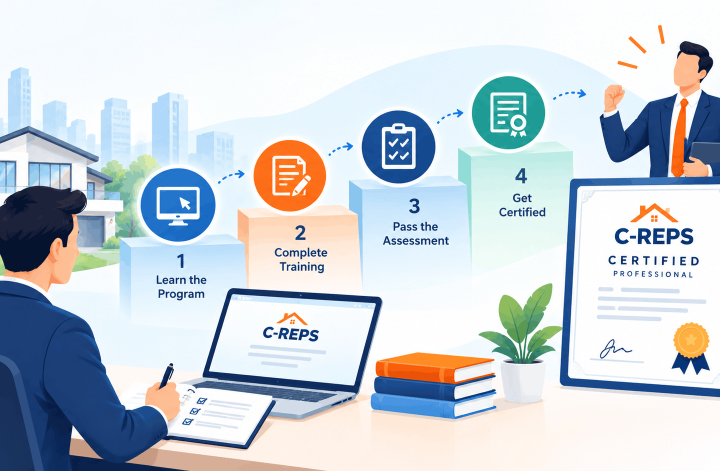
Real estate professionals who want to stand out in a crowded market often look for credentials that signal genuine expertise. The C-REPS designation, short for Certified Real Estate Pricing Specialists, is one of those credentials. It is built around accurate property pricing and local market knowledge, and it asks its holders to meet a higher professional standard than many agents are held to.
This guide walks through what the designation involves, who it is designed for, and the general path toward earning it. Because certification requirements, fees, and program details can change, treat this as an orientation and confirm current specifics with the certifying organization before you commit time or money.
What Is the C-REPS Designation?
C-REPS professionals are active real estate agents and brokers who have completed specialized training in property pricing, passed certification testing, and agreed to follow a professional code of ethics. The designation is administered through the National Association of BPO Professionals (NABPOP) certification program, according to the program materials that describe it.
The core idea is straightforward. Pricing a home well requires more than comparing a few recent sales. It requires understanding what buyers are actually willing to pay in a specific neighborhood at a specific moment. C-REPS aims to formalize that skill set.
Who Is the Certification For?
The designation is intended for licensed professionals in the residential real estate field. Typical candidates include:
- Active real estate agents who want deeper pricing expertise
- Brokers who oversee teams and want a structured, credentialed standard for their agents
- Agents committed to continuing education and long-term professional development
- Professionals who prefer working within a collaborative network rather than as solo practitioners
The designation is not a substitute for an appraisal license. C-REPS professionals are agents and brokers, and the credential reflects their pricing training within that role.
Why Pursue It?
Credentials matter most when they change how clients experience your work. For agents, the C-REPS designation can serve several practical purposes:
- Credibility with sellers: Sellers evaluating listing agents often look for evidence of pricing discipline.
- Differentiation: In markets with many new agents, a specialized credential can help you explain why your approach is different.
- Structured learning: Formal training gives you a repeatable method rather than relying only on instinct.
- Network access: The collaborative model means your clients may benefit from a wider set of certified colleagues.
The designation is most valuable when you use it well. Simply displaying a credential without applying the training rarely changes outcomes for clients.
Step-by-Step: How to Become a C-REPS Certified Professional
The exact steps and requirements should be confirmed with the certifying organization, but the general pathway usually follows this sequence.
Step 1: Confirm You Meet the Baseline Eligibility
Before enrolling, verify that you hold an active real estate license in your state and are in good standing. Certification programs of this type generally assume that candidates are already practicing professionals rather than students.
Step 2: Review the Program Requirements
Request the current candidate handbook or requirements document from NABPOP or the official C-REPS program channel. Look for details on:
- Training hours and format (online, in person, or blended)
- Exam structure, passing standards, and retake policies
- Fees and renewal costs
- Membership obligations and performance expectations
- The code of ethics you will be asked to accept
Step 3: Complete the Specialized Training
The training component is designed to build your pricing methodology. Expect material covering market analysis, comparable property evaluation, adjustments for property differences, and how local conditions affect value. Schedule training in blocks you can actually finish, and take notes you can apply to your own listings and buyer consultations.
Step 4: Prepare for and Pass the Certification Exam
Treat the exam as a test of applied judgment rather than memorization. Practical preparation includes:
- Reviewing the training materials in the order they were presented
- Working through sample pricing scenarios using recent sales in your own market
- Explaining your reasoning out loud, as you would to a seller
- Scheduling the exam only after you consistently perform well on practice material
Step 5: Meet Performance and Membership Requirements
Certification is not a one-time event. The designation typically requires you to maintain membership and meet any performance standards set by the program. Keep records of your activity, client outcomes where permitted, and continuing education credits so renewal is straightforward.
Step 6: Commit to the Code of Ethics
Certified professionals agree to a code of ethics. Read it carefully before you sign. The standard usually covers honesty in pricing, disclosure of conflicts, and fair treatment of clients and colleagues.
Step 7: Maintain Your Designation
Plan for renewal from the start. Set calendar reminders for membership dates and continuing education deadlines, and budget for associated costs.
Comparison: C-REPS Versus Standard Agent Credentials
| Factor | Standard Agent Practice | C-REPS Certified Professional |
| Pricing training | Often learned on the job | Formal, structured training |
| Testing | Licensing exam only | Additional certification exam |
| Ethical commitment | State license requirements | Program code of ethics plus licensing rules |
| Network | Typically independent | Collaborative professional network |
| Ongoing obligations | License renewal | License renewal plus program membership and standards |
This comparison is general. Requirements vary by state and by program, so verify details directly.
Practical Example
Consider an agent named Maria who has been licensed for four years and frequently loses listings because sellers feel her price recommendations are guesses. She decides to pursue the designation. Over several months, she completes the training, builds a habit of documenting every comparable sale she uses, and practices explaining her adjustments to a friend who plays the role of a skeptical seller.
When Maria meets her next prospective seller, she walks through a written pricing analysis that shows each comparable, the reasoning behind each adjustment, and the range of likely outcomes. The seller is not simply impressed by a credential. The seller understands how Maria reached her number, which is the real advantage.
Frequently Asked Questions
What does C-REPS stand for?
C-REPS stands for Certified Real Estate Pricing Specialists. It is a designation for active real estate agents and brokers who complete specialized pricing training and certification.
Who can become a C-REPS professional?
The designation is generally open to licensed real estate agents and brokers. It is not intended for appraisers, who follow a separate licensing track.
Who administers the C-REPS certification?
According to the program materials provided, certification is run through the National Association of BPO Professionals (NABPOP). Confirm current administration details with the organization directly.
How long does the certification process take?
Timelines vary based on training format, study pace, and exam scheduling. Most candidates should plan for several months of preparation, but confirm the current program timeline before committing.
Does C-REPS certification replace a real estate license?
No. The designation builds on an active real estate license. You must remain licensed in your state to hold it.
Is C-REPS certification worth it for a new agent?
It depends on your goals and market. New agents may benefit from the structured training, but should first build foundational experience and confirm the cost and time investment fits their business plan.
How do I know if a C-REPS professional is legitimate?
Check the program’s official directory or ask the agent for their certification details and verification source. Legitimate professionals should be willing to share this information.
Does the designation need to be renewed?
Certification generally requires ongoing membership and standards compliance. Review the renewal requirements in the official program materials.
How Modern Technology Helps C-REPS Agents Serve You Better

Home pricing used to depend heavily on an agent’s memory, a stack of printed listings, and a few phone calls. Today, process automation handles much of the data gathering and organization behind a pricing opinion, which leaves professionals more time to do what technology cannot: interpret what buyers are actually willing to pay in a specific neighborhood, on a specific street, this month. For homeowners, the result is a more accurate price and a more efficient path to closing.
This guide explains how modern tools support real estate valuation accuracy, where human expertise remains essential, and what questions to ask your agent so you can judge the quality of their process for yourself.
What Automation Means in Real Estate Valuation
Process automation in real estate refers to software that performs repetitive research and data tasks without manual effort at every step. In pricing work, that can include pulling recent sales records, matching property features, flagging listings that have changed status, and organizing the results into a clear comparison.
Automation does not decide what a home is worth on its own. It supplies a faster, more complete set of inputs. The professional then reviews those inputs, removes irrelevant data, and applies local judgment.
Automation Versus Manual Research
Manual research relies on one person checking records, sites, and notes one property at a time. That approach works, but it is slow, and it is vulnerable to small errors such as a missed sale, an outdated status, or a mismatch in square footage that quietly distorts a comparison.
Automated workflows reduce those risks by standardizing how data is collected. The same fields are captured for every comparable property, and the same filters are applied consistently. The agent’s role shifts from data clerk to analyst.
Why Valuation Accuracy Matters to Your Bottom Line
A home priced too high may sit on the market, collect fewer showings, and eventually sell for less than it would have with a realistic starting price. A home priced too low leaves money on the table. Either outcome can cost a seller thousands of dollars, and it can cost a buyer the confidence to make a competitive offer.
Accuracy matters for buyers too. An offer based on an inflated sense of value can strain a budget, while an offer based on a thorough analysis gives a buyer a defensible reason for the number they propose.
The Role of Market Timing
Real estate markets shift. Interest rates, inventory levels, and seasonal patterns all influence what buyers will pay. A valuation built on sales from six months ago may no longer reflect current demand. Automated tracking helps professionals spot these changes sooner, so the analysis reflects today’s conditions rather than last season’s.
How Process Automation Improves Efficiency
Efficiency gains are often the first benefit people notice, but they matter because they affect quality. When an agent spends less time on routine tasks, more time remains for property walkthroughs, neighborhood research, and client conversations.
Faster Data Gathering
Pulling records from multiple sources used to take hours. Automated systems can collect and refresh that information in minutes, which means an agent can respond to your questions with current data rather than promising to follow up in a few days.
Consistent Comparable Selection
Choosing comparable properties, often called comps, is one of the most important steps in pricing. Automation applies the same criteria to each comp, such as distance, size, age, condition indicators, and recency of sale. Consistency reduces the chance that a favorable comparison is chosen while a less favorable one is ignored.
Quicker Market Updates
When a comparable property sells, is withdrawn, or changes price, an automated system can flag the change. That alert allows the agent to update the analysis promptly and to explain to you what changed and why.
Clearer Reporting
Many automated tools generate organized reports with charts, adjustment notes, and source references. Clear documentation makes it easier for you to understand the reasoning behind a price, ask informed questions, and compare one agent’s analysis with another’s.
Where Human Expertise Still Leads
Technology is powerful, but it has limits. No software can walk through a home and notice that the roof is near the end of its life, that a renovation was done without permits, or that a busy road creates noise at certain hours. These factors affect value, and they require a trained eye.
Local knowledge is equally important. An algorithm may treat two streets as similar because the homes share square footage and build year. An experienced agent knows that one street has a strong school pipeline, a planned transit station, or a history of flooding that buyers take seriously.
Negotiation and communication also depend on people. Pricing advice has to be explained, questioned, and adapted to your goals, whether you want a fast sale, the highest possible price, or a sale that fits a relocation timeline.
C-REPS Professionals and Technology: A Balanced Approach
C-REPS (Certified Real Estate Pricing Specialists) are active real estate agents and brokers, not appraisers. They are trained, tested, and certified through the National Association of BPO Professionals (NABPOP) certification program, which requires specialized training, certification exams, performance requirements, maintained membership, and adherence to a professional code of ethics.
That combination shapes how C-REPS professionals use technology. Automation supplies speed and consistency. Certification and market experience supply judgment. Membership in a collaborative network adds a second perspective when a property or market is unusual.
It is also important to understand what a pricing opinion is. A comparative market analysis (CMA) prepared by a real estate professional is an estimate of value based on recent market activity. A licensed appraisal is a separate service performed by a licensed or certified appraiser, and lenders often require one for mortgage purposes. Knowing which you need helps you set the right expectations.
Comparison: Traditional Pricing Versus Automation-Supported Pricing
| Factor | Traditional Manual Process | Automation-Supported Process with Professional Review |
| Data collection | Manual searches across several sources | Systematic pulls from multiple sources with regular refreshes |
| Speed of updates | Dependent on how often the agent checks | Alerts when comparable properties change status |
| Comparable selection | Varies by individual approach | Applies consistent criteria, then reviewed by the agent |
| Documentation | Often informal or handwritten | Organized reports with supporting data |
| Local judgment | Strong when experienced | Equally strong, supported by better data |
| Risk of missed data | Higher with large data volumes | Lower, though review is still essential |
The most reliable approach combines both columns: technology for thoroughness and an experienced professional for interpretation.
Practical Examples
Examples make the process easier to picture. The scenarios below are illustrative and do not describe any specific transaction.
Home Seller Example
A family preparing to sell a three-bedroom home asks for a pricing analysis. The agent’s automated system gathers recent sales within a defined radius, filters for similar size and age, and flags two nearby homes that were withdrawn from the market this month. The agent reviews the list, removes one comparable that had a major structural issue, and adjusts for a recent kitchen renovation on the seller’s home. The seller receives a clear report explaining why a specific price range is recommended and how it may change if market activity shifts.
Home Buyer Example
A buyer is deciding how much to offer on a townhouse. Rather than relying on the listing price, the agent provides recent sales of similar units, notes how long comparable homes stayed on the market, and explains which features justify a premium and which do not. The buyer makes an offer based on evidence and feels comfortable with the negotiation strategy.
Investor Example
An investor evaluating a rental property wants to know whether the asking price aligns with local values. The agent uses automated tracking to compare recent sales of similar properties, then adds local context about rental demand, vacancy patterns, and planned infrastructure projects. The investor gains a clearer picture of value and a more realistic expectation of returns.
Actionable Steps for Sellers, Buyers, and Owners
Whether you are selling, buying, or simply want to understand your property’s value, these steps will help you make better decisions.
- Ask for the data behind the number. A reputable agent should be able to show you the comparable properties and explain why each one was included or excluded.
- Request a current analysis. Pricing based on sales from several months ago may not reflect today’s market.
- Compare more than one opinion when the stakes are high. Speaking with two qualified professionals can reveal differences in approach and local insight.
- Clarify the purpose of the estimate. A listing price strategy, an offer strategy, and a mortgage appraisal serve different goals.
- Look for a process, not just a promise. Ask how the agent updates data, verifies comparables, and handles unusual properties.
- Keep your property records current. Renovation receipts, permits, and maintenance logs help your agent account for improvements accurately.
Questions to Ask Your Agent About Technology
Asking the right questions reveals how thoughtfully an agent uses tools. Consider asking how often their data is refreshed, which sources they rely on, and how they verify that a comparable property is truly comparable. Ask what they do when automated results conflict with what they see on the ground, and how they explain adjustments to you.
A good answer will emphasize transparency and professional judgment. Be cautious of anyone who promises a precise value without explaining the method behind it.
Frequently Asked Questions
How does automation improve real estate valuation accuracy?
Automation gathers and organizes sales data more quickly and consistently than manual methods. This reduces the chance of missed records, outdated information, and inconsistent comparable selection. Accuracy still depends on professional review, because local conditions and property details require human judgment.
Does automation replace a real estate agent’s pricing expertise?
No. Automation handles data collection and organization, while the agent interprets that data, evaluates property condition, and considers neighborhood factors. The combination of technology and expertise produces more reliable results than either alone.
What is a C-REPS professional?
C-REPS stands for Certified Real Estate Pricing Specialists. These are active real estate agents and brokers who complete specialized training, pass certification exams, meet performance requirements, maintain membership, and follow a professional code of ethics through the NABPOP certification program.
Is a C-REPS pricing analysis the same as an appraisal?
Not exactly. A pricing analysis, such as a comparative market analysis, estimates value based on recent market activity and is prepared by a real estate professional. An appraisal is performed by a licensed or certified appraiser and is often required by lenders for mortgage purposes.
How often should a home’s value be updated?
Values can change with market conditions, so an analysis that is several months old may not reflect current activity. If you are planning to sell or make an offer, request a current analysis close to the time of your decision.
Can technology account for home improvements and condition?
Automated systems can record features you provide, such as square footage, updates, and upgrades. However, condition is best assessed in person. A professional walkthrough allows your agent to verify features and identify issues that data alone would miss.
What should I ask a real estate agent about their pricing process?
Ask where their data comes from, how often it is refreshed, how they select comparable properties, and how they handle unusual homes. Request to see the supporting comparables and ask them to explain any adjustments in plain language.
Will automated pricing tools work well in every neighborhood?
Automation performs best where there is a reasonable volume of recent sales. In unique properties or thin markets, there may be fewer comparables, so professional judgment becomes even more important. A good agent will tell you when the available data is limited.
Working With a C-REPS Professional
Technology is changing how real estate professionals work, but the goal remains the same: helping you make confident decisions about one of the largest financial choices in your life. C-REPS professionals combine certified training, local market knowledge, and modern tools to deliver pricing that reflects what buyers are willing to pay today.
If you are thinking about selling, buying, or understanding the value of your property, consider speaking with a C-REPS professional. Ask to see how their process works, and let the quality of their answers guide your decision.